


Your child aces Friday’s spelling test. By Sunday, they write the same word wrong in their journal, then sigh at the kitchen table and say, “I’m just bad at spelling, Mom.” You wonder whether more practice is the answer. Before you have them write it ten more times, look at the mistake. Did they leave out a sound, spell the word how it sounds, or get it right on the test but miss it in real writing?
Spelling can feel random, but most English words follow patterns children can learn.¹ Real spelling help starts with understanding what kind of mistake keeps happening, not just adding more practice.
Step 1: Notice What Kind of Mistake Keeps Happening
Before you add more practice, look at the actual mistake. Ask your child to write the word from memory, no looking at the list, then look at it together. Where did it go wrong? That one spot is what you’re going to work on. A child who writes frend is close; they heard the sounds, just missed the pattern. A child who writes mst for must is leaving out a whole sound. Different problems, different fixes.
If the same mistake keeps showing up, you have something more useful than “they got it wrong.” You can say, “She keeps missing the middle vowel,” or “He gets it on the test but not in writing.” That is easier to act on than “spelling is hard.”
Want a simple way to try this at home? Download the Spelling Pattern Practice Sheet to spot the tricky part, practice from memory, and move the word into real writing.
Step 2: Match the Practice to the Mistake
Not every activity works for every problem. The key is matching what you do to what you noticed in Step 1.
Cover-Write-Check
Use this when your child has practiced a word multiple times but still can’t get it right on their own.
Example: becuase / becasue → because
Show the word for 5 to 10 seconds, then cover it. Your child writes it from memory, uncovers it, and checks. If it’s wrong, look at the specific error together, not the whole word. Then try once more. Come back to that word the next day.
Skip the rainbow writing or copying words ten times as the main strategy. Writing from memory is harder, but that’s what makes it stick. Research on retrieval practice shows this kind of try-check-fix routine works better than copying words repeatedly, with gains that hold up weeks later.² ³
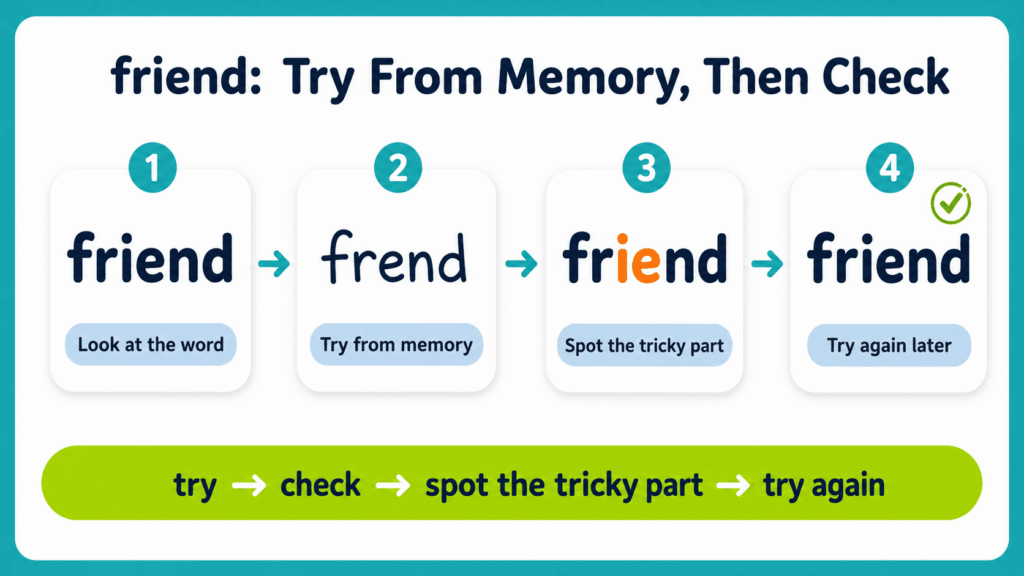
Hot Spot Marking
Use this when your child gets most of the word right but keeps missing one specific spot.
Example: seperate → separate
After your child attempts the word, ask: “Which part tripped you up?” Then, have them rewrite the word using a different color or bigger handwriting for just the tricky letters.
The message is simple: you already know most of this word. We’re fixing one spot.
Zooming in on the hard part helps your child remember the exact place that keeps going wrong. That feels very different from rewriting the whole word again and again.
Say It Funny
Use this when your child misses letters that are there in print but disappear in speech.
Examples: nife → knife, rong → wrong, lam → lamb
Together, exaggerate the tricky letter out loud. Pronounce the b in lamb, the k in knife, or the w in wrong.
Your child uses that funny pronunciation as a memory hook when writing. It sounds silly, but that’s the point. The odd sound makes the tricky letter harder to forget.
Word Sort
Use this when your child keeps mixing up similar spelling patterns.
Examples: rane → rain, plai → play
Write 8 to 12 words on index cards. Label two or three columns, for example, “words with ai” and “words with ay.” Your child sorts the cards, reads each word aloud, and explains why each column belongs together.⁴
After the sort, set a 5-minute timer and have them find matching words in a book they’re already reading.
Sorting makes your child think about why words go together, not just memorize them one by one. Finding those same patterns in a real book reinforces that spelling is not something that lives only on a list.
Spelling Journal
Use this when your child spells a word correctly on Friday’s test, then misses it in real writing a few days later.
Example: freind / frend → friend
Give your child a small notebook. After practice, they pick three words and write a sentence for each about something they actually care about: their pet, a game they like, a favorite food, whatever feels real to them.
The word starts to live inside real writing, not just on a spelling list. That creates a stronger connection than drilling it on a worksheet.
For kids whose spelling falls apart when they have to hold the word in mind while also managing ideas and punctuation, Working Memory Activities for Kids covers useful background.
Step 3: Keep It Short, Keep It Daily
A few minutes every day beats a long session once a week. Ten minutes is enough. Do not re-drill the whole list. Only target the words that failed in Step 1.
A simple weekly rhythm: pick the three to five hardest words on Monday. Practice with the matched activity Tuesday through Thursday. Let Friday’s test happen without cramming. Spreading practice across the week helps words move into long-term memory, not the last-minute session the night before.
What to Do When Spelling Hurts Confidence
Some kids stop using harder words because they are afraid of spelling them wrong. They write happy when they meant delighted, not because their vocabulary is small, but because the safer word will not get marked wrong.⁵
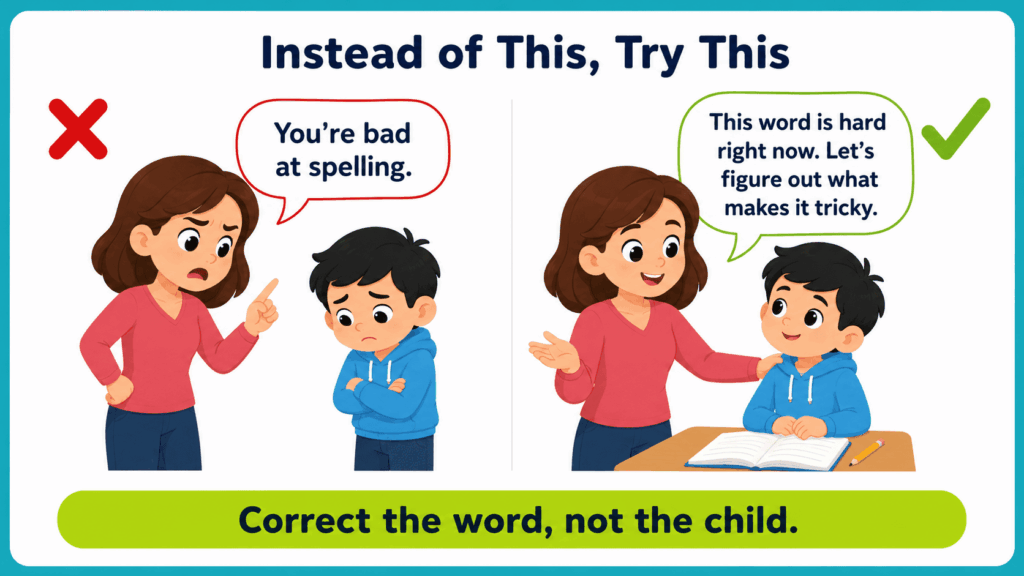
Instead of “You’re bad at spelling,” try: “This word is hard right now. Let’s figure out what makes it tricky.”
During free writing, do not stop every sentence to correct spelling. Let the idea come out first. Once your child finishes, pick one word or one pattern to review together on a separate piece of paper, away from the writing they just worked on. That keeps spelling from taking over the whole writing task.
Correct the word, not the child.
When to Talk to Your Child’s Teacher
Most spelling mistakes are part of learning. But if the same errors keep showing up across homework, writing, and tests, not just on Friday’s quiz, it is worth a conversation.
The same goes if your child is avoiding writing because of spelling, if spelling struggles come alongside reading difficulties (see Why Is My Child Struggling With Reading?), or if they consistently shut down during homework.
If these patterns keep showing up, bring them to the teacher. You are not diagnosing anything. You are describing what you see.
See also Why Is My Child Struggling in School? and Executive Functioning Skills for Kids.
Understand Your Child’s Learning Profile With Kidaro
Kidaro helps parents understand how their child learns, practically, not clinically. Sometimes spelling is the visible problem, but the pattern underneath matters more.
Is your child losing the sound sequence? Forgetting the pattern once writing gets longer? Getting overwhelmed when an assignment has multiple steps? A Learning Profile helps you get more specific, so support at home feels less like guessing.
See What Is My Child’s Learning Style? for related background.

Stop guessing what’s actually getting in the way.
Sources
- Joshi, R. M., Treiman, R., Carreker, S., & Moats, L. C. “How Words Cast Their Spell: Spelling Instruction Focused on Language, Not Memory, Improves Reading and Writing.” American Educator, Winter 2008–2009.
- Jones, A. C., Wardlow, L., Pan, S. C., Zepeda, C., Heyman, G. D., Dunlosky, J., & Rickard, T. C. “Beyond the Rainbow: Retrieval Practice Leads to Better Spelling than Does Rainbow Writing.” Educational Psychology Review, 28(2), 385–400. 2016.
- Veiga da Silva, F., Ekuni, R., & Jaeger, A. “Retrieval Practice Benefits for Spelling Performance in Fifth-Grade Children.” Memory, 2023.
- Bear, D. R., Invernizzi, M., Templeton, S., & Johnston, F. Words Their Way: Word Study for Phonics, Vocabulary, and Spelling Instruction. 7th ed. Pearson, 2024.
- Sumner, E., Connelly, V., & Barnett, A. L. “The Influence of Spelling Ability on Vocabulary Choices When Writing for Children With and Without Dyslexia.” Journal of Learning Disabilities, 49(3), 293–304. 2016.
- International Dyslexia Association. “Spelling Fact Sheet.”
More for Parents:
- How to Motivate Kids to Study Without a Fight
- How to Calm a Dysregulated Child
- How to Help My Child With Math
- Helping Kids Overcome Procrastination
- Why Your Child Hates School
- Homework Without the Fight
- Helping Kids With Executive Function
- Adaptive Learning Technology for Kids
- Understanding How Children Learn
- Capable Kids Who Struggle
- What Age Do Children Learn to Read?

Written by
Kidaro Team