


You sit down at the kitchen table to help with math homework. The problem is something like 47 + 36. You know the answer. You have known how to do this since third grade.
But your child’s worksheet is not asking them to stack the numbers and carry the one. It is asking them to draw boxes, jump along a number line, or explain the answer in words.
A lot of parents get stuck there, not because the math is hard, but because nothing on the worksheet looks like the math they learned.
If math homework has become a repeated fight at home, you may also want to read our guide on how to help your child with math.
What “New Math” Actually Means
So what actually changed? When parents say “new math,” they usually mean the methods they see on homework: number lines, area models, decomposing numbers, and written explanations.
These methods are often connected to Common Core, but Common Core is not a math program. It is a set of learning goals. The actual methods usually come from the curriculum your school district chose.¹
The goal is not to replace the standard way. Children still learn stacking, carrying, borrowing, and long division. Many programs just spend more time first helping children understand what those steps mean.
The broader pattern is real: many elementary programs now use drawings, number lines, area models, and explanations before moving toward faster standard procedures.
Old Math vs New Math: The Core Difference
Old math usually started with the procedure: stack the numbers, carry the one, borrow from the tens place, follow the steps.
Newer approaches tend to flip that: meaning first, speed second. A child might break a number apart, draw a model, or explain their thinking before using the shortcut.
Old math works. New math is not a replacement for it. Children need both: a real sense of what numbers mean and the ability to calculate quickly and accurately. The best way to see the difference is in the actual methods, side by side.
Old Math vs New Math Examples
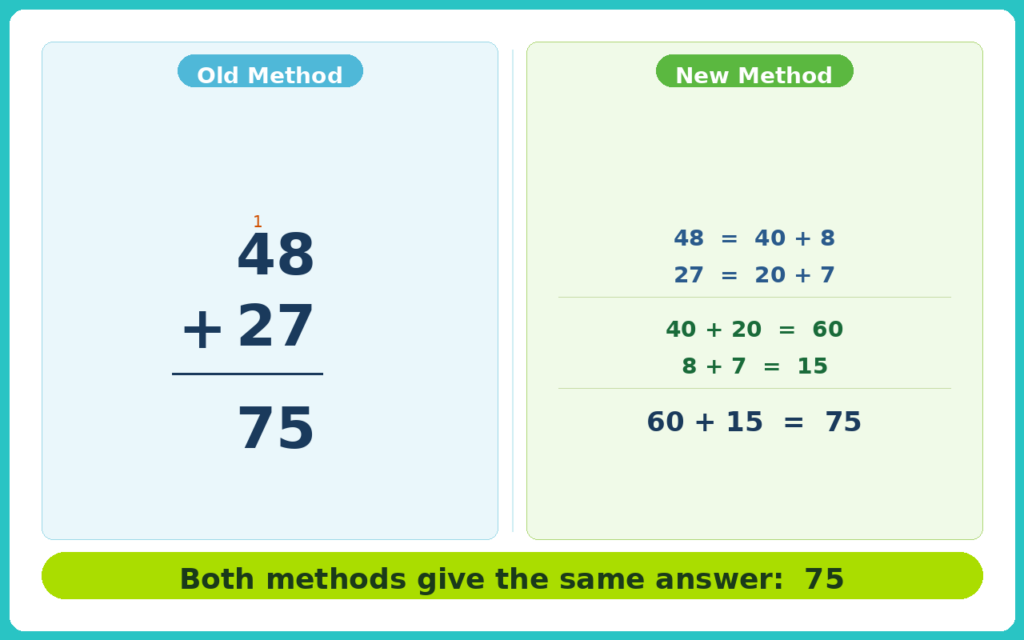
Addition: 48 + 27
Old method:
Stack the numbers vertically. Add the ones column: 8 + 7 = 15. Write the 5, carry the 1. Add the tens: 4 + 2 + 1 = 7. The answer is 75.
New method:
Break each number into tens and ones.
48 = 40 + 8
27 = 20 + 7
Add the tens: 40 + 20 = 60
Add the ones: 8 + 7 = 15
Then combine: 60 + 15 = 75
What it teaches:
The child sees that the 4 in 48 means 40. They are doing the same thinking behind carrying, but in a way they can see.
Where kids get stuck:
Breaking numbers apart can feel slow. If they are still shaky on basic facts like 8 + 7, they may lose track halfway through.
What you can do:
Ask, “What does the 4 in 48 mean?” If they can say “forty,” the method usually starts to make more sense. If they cannot, you have found the real gap.
If your child often loses track of steps or forgets what they just did, our guide to working memory in children explains why that can happen during schoolwork.
Subtraction: 43 − 17
Old method:
Since 3 cannot subtract 7, borrow from the tens place. The 4 becomes 3, and the 3 becomes 13. Then 13 − 7 = 6 and 3 − 1 = 2. The answer is 26.
New method:
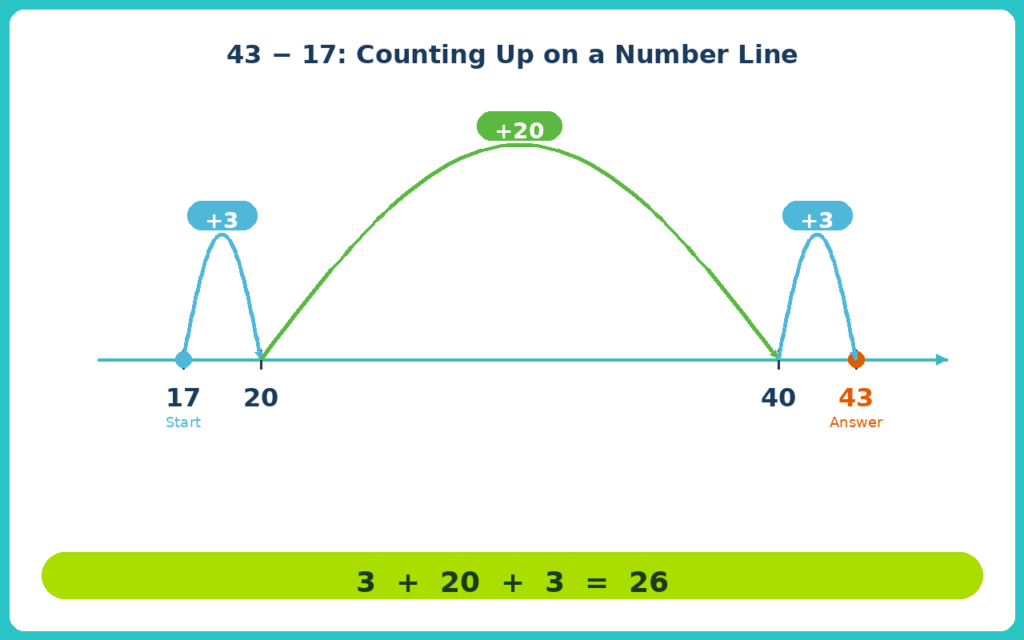
Start at 17 and count up to 43.
17 to 20 is +3
20 to 40 is +20
40 to 43 is +3
Add the jumps: 3 + 20 + 3 = 26
Another method is to break apart 17:
43 − 10 = 33
33 − 7 = 26
What it teaches:
Subtraction is not only “taking away.” It can also mean finding the distance between two numbers, similar to what adults do when giving change.
Where kids get stuck:
The number line can feel backwards. Some kids also lose track of the jumps.
What you can do:
Try framing it as a distance question: “Where are we starting, and where are we trying to get?” That usually works better than pushing them straight into “take away.”
Multiplication: 6 × 8
Old method:
Memorize the fact: 6 × 8 = 48.
New method:
Use a fact the child already knows.
6 × 5 = 30
6 × 3 = 18
30 + 18 = 48
Or:
3 × 8 = 24
So 6 × 8 is double that: 48
What it teaches:
A child does not have to treat every multiplication fact like a separate thing to memorize. They can use facts they know to figure out facts they do not know yet. The same idea helps later when bigger math problems need to be broken into smaller parts.
Where kids get stuck:
They may not know which fact to start with. If they do not know their 5s, doubles, or 10s well, this method can feel harder than it needs to.
What you can do:
Keep practicing basic facts. Games, songs, and flashcards can still help. Fact fluency makes these strategies easier, not less useful.
Multi-Digit Multiplication: 27 × 12
Old method:
Use the standard algorithm.
27 × 2 = 54
27 × 10 = 270
54 + 270 = 324
This works, but many children do not understand why the second row shifts left.
New method:
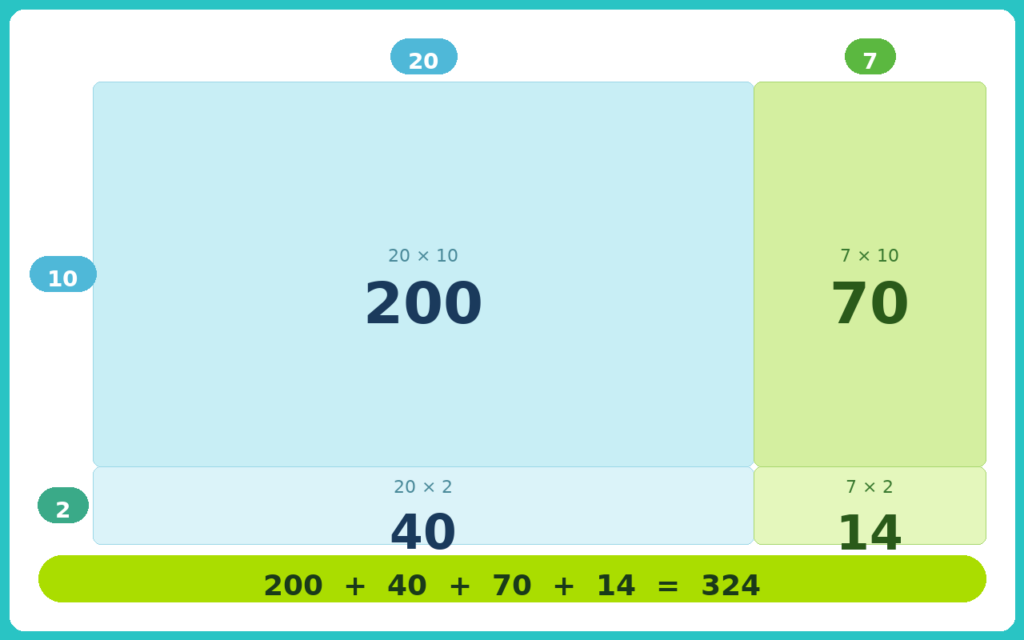
Use an area model.
Break 27 into 20 + 7.
Break 12 into 10 + 2.
Then multiply each part:
20 × 10 = 200
20 × 2 = 40
7 × 10 = 70
7 × 2 = 14
Add them together:
200 + 40 + 70 + 14 = 324
What it teaches:
The model shows why each part of the multiplication matters. It makes place value visible.
Where kids get stuck:
They may set up the rectangle incorrectly or forget to add one of the partial products. Parents often find this method frustrating because it looks longer than the standard algorithm.
What you can do:
Start with place value. If your child understands 27 as 20 + 7, the model becomes much easier to follow. If they do not, the area model is not the problem. Place value is.
For a deeper breakdown of this specific strategy, read our guide on what the area model is in math.
Division: 174 ÷ 6
Old method:
Use long division: divide, multiply, subtract, bring down, and repeat. The answer is 29.
New method:
Use partial quotients.
Ask: how many 6s fit into 174?
Start with a friendly number:
6 × 10 = 60
174 − 60 = 114
Another 10 groups:
114 − 60 = 54
Now:
54 ÷ 6 = 9
Add the parts:
10 + 10 + 9 = 29
What it teaches:
Division means finding how many groups fit into a number. The child is using friendly chunks instead of trying to remember a full procedure all at once.
Where kids get stuck:
They may choose chunks that are too small, which creates too many steps. They may also lose track of what they already subtracted.
What you can do:
Look for a friendly chunk. If your child chooses 60 because 6 × 10 = 60, they are thinking in the right direction.
Fractions: 1/2 + 1/4
Old method:
Find a common denominator.
1/2 = 2/4
2/4 + 1/4 = 3/4
New method:
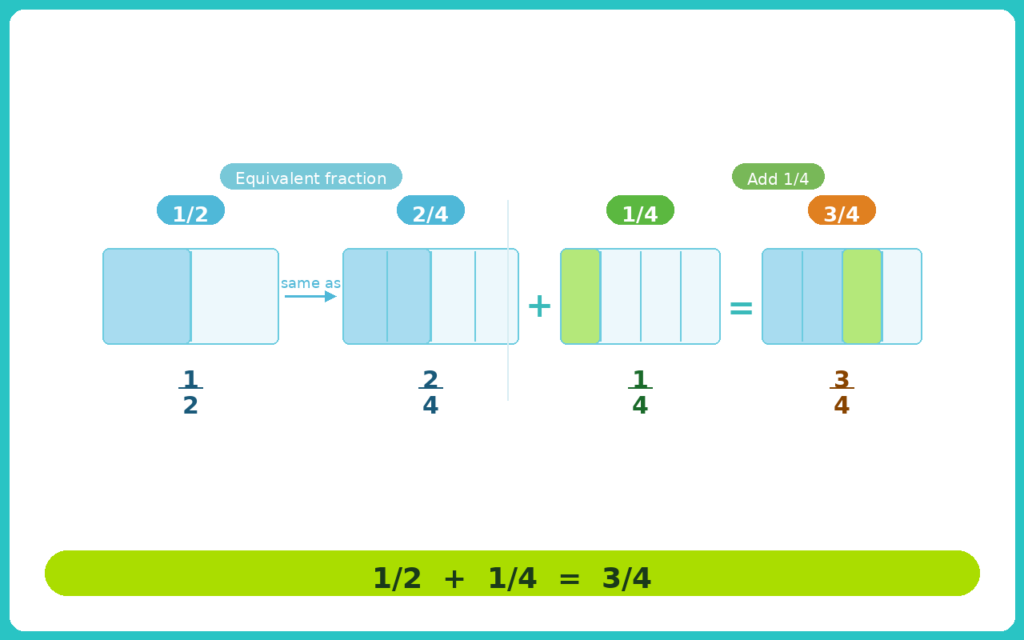
Use a visual model first.
Draw a rectangle. Split it in half and shade one half. Then split each half into two equal pieces. Now the rectangle is divided into fourths.
The shaded half is the same as 2/4. Add one more fourth, and the total is 3/4.
What it teaches:
Fractions can only be added when the pieces are the same size. The common denominator rule is not random. It is a shortcut for making the pieces match.
Where kids get stuck:
They may draw uneven pieces or struggle to move from the picture back to the written fraction.
What you can do:
Use something physical. Fold a piece of paper in half, then fold each half in half again. When the pieces are visible, the idea often clicks faster.
Why Schools Teach Math This Way
After seeing all of that, it is fair to ask: why go through so many steps?
Most of these methods exist for a reason. A 2022 review describes number sense as a foundation of early math learning.² Visual models can reduce how much a child has to hold in their head at once, which matters because working memory is closely connected to math problem-solving.³ Asking children to explain their thinking can also help them check whether they understand what they are doing.⁴
These methods slow math down long enough for children to see what is happening before they rely on the shortcut.
For a closer look at the thinking behind Common Core standards and what drove the shift, this breakdown of Common Core vs traditional math covers the history well.
How to Help Your Child With New Math Homework
You do not need to master every method your child’s school uses. A few calm moves can keep you from accidentally taking over.
Start by asking your child to show you what they learned.
Try:
- “Can you show me how your teacher did this?”
- “What part makes sense so far?”
- “What is this drawing supposed to show?”
- “Where did you start on the number line?”
- “Can we try your class method first, then use my way to check?”
It keeps the homework about what they already started, not what you would do differently.
Be curious before correcting. A child who is already confused can shut down quickly if they feel like their method is wrong. Asking questions gives them a chance to show what they know. And do not mistake needing more steps for being behind. A child working through six steps may be building the foundation that makes the shortcut possible later.
If the same method keeps causing confusion, ask the teacher for one worked example. A single example can clear up a lot, especially when the homework directions are vague.
More help is not always better, and the research backs that up. A 2023 study found that uninvited, intrusive homework support was linked with lower math achievement over time for children with a fixed mindset.⁵ The better move is to stay available without hovering over every step.
Understand How Your Child Learns Math
Most of the guidance in this article assumes the method is the problem. Sometimes it is. But sometimes a child struggles because they lose track of steps, because visuals overwhelm rather than help, or because they understand the math but freeze when asked to explain it.
Those are different problems.
Kidaro helps parents understand their child’s Learning Profile: where they tend to get stuck, what kind of explanation lands, and what makes homework harder even when everyone is trying. Not a diagnosis. Just a clearer picture of what may help.
If math struggles seem to keep showing up in different ways, our guide on why children struggle with math can help you think through what may be underneath the pattern.

Stop guessing what’s actually getting in the way.
FAQs
Sources:
1. Common Core State Standards Initiative. Frequently Asked Questions.
5. Park, D., Gunderson, E. A., Maloney, E. A., Tsukayama, E., Beilock, S. L., Duckworth, A. L., & Levine, S. C. (2023).Parental Intrusive Homework Support and Math Achievement: Does the Child’s Mindset Matter? Developmental Psychology / ERIC.
More for Parents:
- Why Is My Child Struggling With Reading?
- How to Motivate Kids to Study
- What Is My Child’s Learning Style?
- Emotional Regulation in Children
- Adaptive Learning for Kids
- Executive Functioning Skills for Kids
- Working Memory Activities for Kids
- Why Is My Child Struggling in School?
- Stop Kids From Procrastinating
- Why Children Dislike School
- Spelling Support for Kids
- How to Help Children With Homework
- How to Build Executive Function in Kids
- What Is Personalized Learning for Kids
- What Helps Kids Learn
- Smart Child Not Performing Well

Written by
Kidaro Team