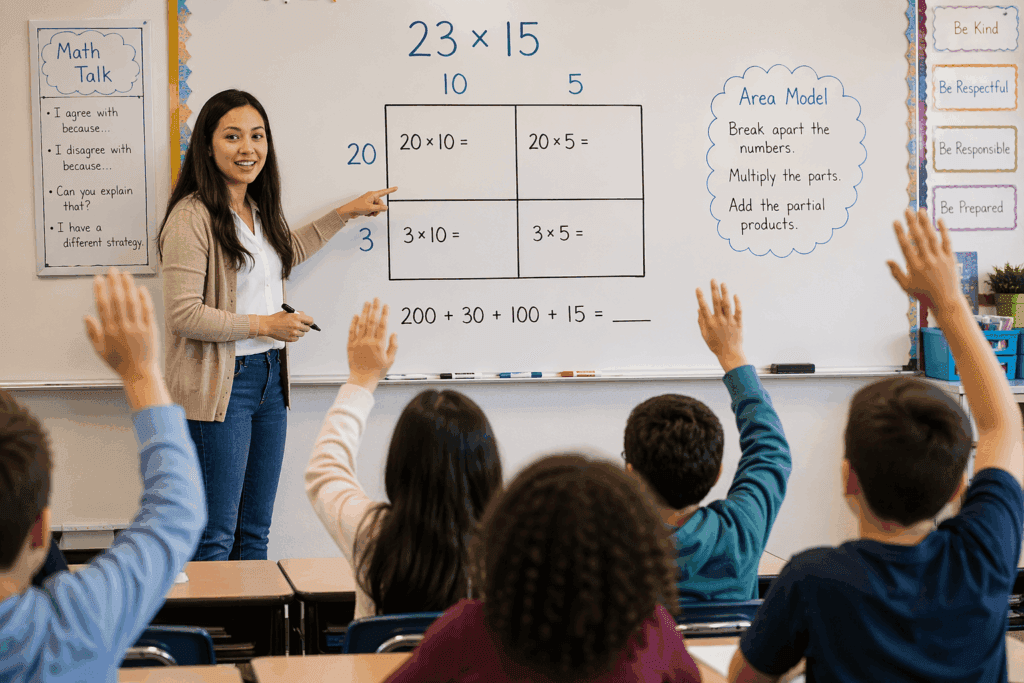


It’s 7 p.m. You’ve just gotten home, set your things down, and asked the question you already feel tense asking: “Did you finish your math homework?”
They haven’t. The excuses start, the worksheet comes out, and within a few minutes they are guessing, freezing, or saying they do not get it. You feel yourself getting frustrated, but you also know this is not just laziness. Something about math is not clicking, and you are not sure how to help without adding more pressure.
A lot of parents assume they need to explain math better. Sometimes that helps. But a lot of the time, the more useful starting point is noticing where the problem breaks down. Is your child losing track halfway through? Rushing through word problems? Memorizing steps without understanding them? Freezing when the worksheet changes format?
That is what this guide is meant to help with. Not turning you into a math teacher. Not filling your home with more worksheets. Just helping you spot the pattern, lower the pressure, and use practical strategies that can make math clearer at home.
If you are still trying to figure out why math has become a struggle in the first place, read our in-depth guide on why your child may be struggling with math.
Start by Figuring Out What Part of Math Feels Hard
A lot of math help goes wrong because adults treat math as one big subject instead of a set of different demands. A child may be fine with basic facts but fall apart on word problems. Another may calculate correctly but gets lost halfway through anything with multiple steps. Another may seem okay until the worksheet changes format and then suddenly freezes.¹
This is where it is easy to miss what is actually going on. The question is not just, “Is my child struggling with math?” It is, “What kind of math situation causes the stall?”
Here’s a simpler way to look at it:
| What you’re seeing at home: | What might actually be happening: |
| They can do it one day and forget it the next | Working memory load may be part of the issue¹ |
| They rush through word problems and miss the question | Language and organization may be getting in the way⁵ |
| They get lost halfway through longer problems | They may be overloaded by multi-step thinking¹ ⁵ |
| They struggle more with shapes, area, or diagrams | Visual-spatial reasoning may be harder here |
| They get the answer but cannot explain it | They may be relying on memorized steps without real understanding⁴ |
That kind of noticing helps a parent move from “my child is bad at math” to “my child gets stuck in this specific kind of math situation.” That is a much more useful place to start.
If math seems to be only one part of a bigger pattern, you may also want to read our guide on why your child may be struggling in school overall.
Help Them Build Number Sense Before Pushing More Practice
Number sense is not just something to work on when a child is struggling. It is one of the most useful parts of learning math well in the first place. It helps children see how numbers relate to each other, make better estimates, and solve problems in a way that feels more flexible instead of mechanical.⁴
A child with a strong number sense is more likely to think, “I know 8 + 8 = 16, so 8 + 7 must be one less.” It is what helps them notice when an answer seems impossible, estimate before counting, or use a number they already know to figure out one they do not.⁴
At home, this can be built in ordinary ways. If a child is stuck on 29 + 30, a parent might say, “What do you already know about 30 + 30?” If a child is working on multiplication, a parent might ask, “If 5 groups of 6 is 30, what would 6 groups of 6 be?” The point is not to turn every moment into a lesson. The point is to help the child see relationships instead of treating every fact like a separate thing to memorize.
Real objects can help too, especially when numbers still feel abstract. Grouping coins into tens, making equal piles of crackers, or estimating before counting can all make numbers feel more visible and connected.³ ⁵
Slow Down Word Problems and Multi-Step Math
Word problems and multi-step questions overload a lot of children because they combine reading, memory, organization, and calculation all at once.¹ ⁵ Too many things are happening at once.
If your child tends to lose the thread halfway through, it may help to read more about how to improve working memory in children.
That is why “just read it again” usually does not help much. What helps more is giving the child a simple structure that reduces how much they have to juggle mentally:¹
- What is happening in the problem?
- What am I trying to find?
- What information matters?
- What is my first step?
If the problem says Maya has 24 stickers, gives 7 away, then buys 12 more, stop before any calculation and ask, “Tell me the story first.” Then ask, “What changed first?” and “What are we trying to know at the end?” That pause often stops the child from grabbing numbers and doing random operations.
Drawing the problem can help even more. If the child sketches 24 stickers, crosses out 7, and adds 12, the sequence becomes visible. If they tend to get lost halfway through, cover the rest of the page and work one step at a time. That is not lowering the bar. It is reducing overload so the child can actually use what they know.¹ ⁵
That same idea carries over into other parts of math too. A lot of the time, children do better when math feels tied to something they can see, touch, measure, or picture, instead of staying stuck on a worksheet full of symbols.
Use Real Objects and Everyday Situations Before Jumping to the Worksheet
Everyday situations help because they give numbers a job to do. Cooking can make fractions and measurements feel real. Shopping can help with estimation, money, and percentages. Time gets easier when it connects to something concrete, like leaving for practice or getting somewhere on time.
That same principle applies when a child needs help making sense of a concept. If fractions are confusing, it usually helps more to cut toast, fruit, or pizza into parts than to start with a page full of fraction symbols. If place value is shaky, grouped objects can make tens and ones more visible. If a word problem feels abstract, acting it out or sketching it can make the structure easier to follow.³ ⁵
This matters because children are often expected to work at the symbol level before the concept feels solid. They can sometimes get by for a while by memorizing steps, but that tends to break when the numbers change or the format becomes less familiar. A row of coins, a quick sketch, a block model, or something they can measure in real life gives them something to think with.³ ⁴ ⁵
This can be especially helpful in geometry and visual-spatial math. A child who does not fully understand symmetry, area, rotation, or shape relationships may do much better if they can fold paper, build a shape, compare household objects, or rearrange pieces instead of only looking at a printed diagram.³
If your child tends to learn better when something is concrete, visual, or hands-on first, it may help to understand more about how children learn best.
You Do Not Have to Explain Every Math Concept Yourself
Many parents pull back from math help because they are afraid of explaining it wrong. That pressure is understandable, but unnecessary. Sometimes a child understands a concept faster when they hear it from another voice, see it shown visually, or watch it broken into smaller steps.⁴
That is where short, high-quality educational videos can help. They give children another way into the same idea, especially when a concept has not clicked through homework, classroom instruction, or a parent’s explanation. The key is choosing videos on purpose, not just handing over the screen. Here are a few math YouTube channels that can be genuinely helpful to follow.
- Numberblocks – good for younger children and especially helpful for making number relationships visible in a way that is easy to follow
- Khan Academy Kids – structured, clearly educational, and built for active learning rather than passive watching
- Math Antics – strong for elementary and middle elementary concepts, with direct explanations and a visual focus
The key is to use videos as support, not as a handoff.
What matters is not just the watching. It is what happens right after. Even a short follow-up can help:
- What part made sense?
- What part still felt confusing?
- Can you show me how they did that?
- Do you think you could try one like it?
Those questions help the child replay the explanation in their own words, which makes it more likely to stick. They also help you catch false confidence. A child may say “I get it” right after a video, but when they try to explain it or do one example, the real sticking point becomes clearer.²
If they can explain it, they understand it. If they can’t, you’ve just found the gap.
If your child resists math before they even get started, it may also help to read our guide on motivate children to study.
When It Helps to Look More Closely at How Your Child Learns
Sometimes math struggles are not mainly about effort or even the concept itself. Sometimes the bigger issue is how a child processes instructions, how much information they can hold at once, how they respond under pressure, or what kind of explanation makes the most sense to them.¹ ²
That is why two children can struggle with the same worksheet for very different reasons. Same worksheet. A completely different problem.
A lot of the time, the most useful shift is not trying to explain harder. It is getting clearer on the pattern. One child may have a number sense gap. Another may understand the concept but lose track of the steps. Another may know what to do in a calm setting but shut down when the task feels high pressure.¹ ² ⁴
When a parent starts to see those patterns more clearly, support usually gets better too. Homework becomes less about pushing harder and more about matching the help to the actual sticking point.
Understand Your Child’s Learning Profile With Kidaro
If math has become a repeated source of confusion, it can help to step back and look at the bigger learning picture. Kidaro is designed to help parents better understand how their child learns in a practical, non-clinical way. It is not a diagnostic tool, and it is not about putting a label on a child.
It is about helping parents make better sense of patterns they are already noticing at home. That can make it easier to support schoolwork, ask better questions, and have more grounded conversations with teachers.

Stop guessing what’s actually getting in the way.
FAQs
Sources
- “7 Research-Backed Ways to Boost Working Memory in Math.” Edutopia, George Lucas Educational Foundation.
- “How to Help Kids With Math Anxiety.” Child Mind Institute.
- “Five Ways Manipulatives Can Be Used to Develop Mathematical Understanding.” Education Endowment Foundation.
- “Mathematical Mindsets.” YouCubed, Stanford Graduate School of Education.
- “Assisting Students Struggling with Mathematics: Intervention in the Elementary Grades.” Institute of Education Sciences, What Works Clearinghouse, U.S. Department of Education.
More for Parents:
- Learning Styles for Kids
- What Is My Child’s Learning Style
- Adaptive Learning for Kids
- Working Memory Activities for Kids
- How to Help My Child With Reading
- Why Is My Child Struggling With Reading
- What Is the Area Model in Math
- Overcoming Procrastination in Kids
- My Child Hates School
- How to Help Kids With Spelling
- How to Help Kids With Homework
- Executive Functioning for Children
- Adaptive Learning and Kids
- How Children Learn Best
- Why Gifted Kids Struggle

Written by
Kidaro Team