

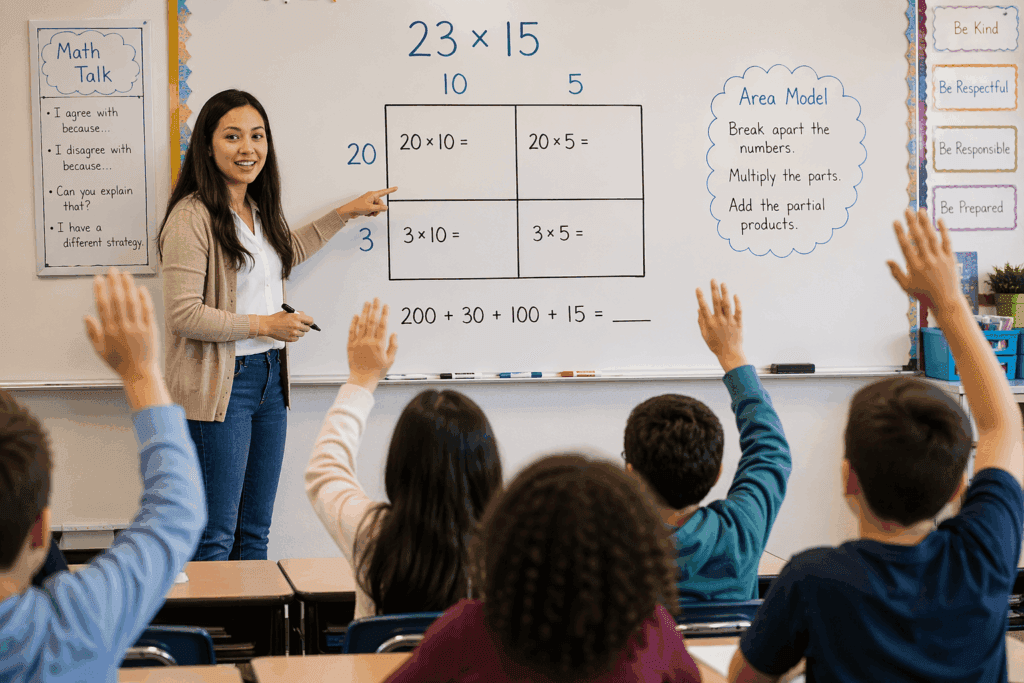
If your child came home with a rectangle full of smaller boxes and numbers, and you had no idea what you were looking at, this is for you.
The area model is a visual way to break multiplication into smaller parts. Schools use it to help children see what the numbers are doing, not just memorize steps.¹ ³
If you’re a parent looking for more in-depth, practical ways to help at home, read our guide on How to Help My Child With Math.
What Is the Area Model in Math?
The area model is a rectangle used to show multiplication visually.¹ ²
One number goes across the top. The other goes down the side. If a number has more than one digit, it gets broken into place value parts, like 23 becoming 20 + 3. The rectangle is then split into smaller boxes, and each box shows one smaller multiplication problem. Add those smaller answers together, and you get the full product.² ⁵
You might also hear it called the box method or an area diagram.³ ⁴ The name can vary, but the idea is the same.
Why Do Schools Use the Area Model?
Schools teach the area model because it helps children understand multiplication before they rely on a faster shortcut.³ ⁵
Instead of just following steps, children can see that a problem like 4 × 23 is really 4 × 20 plus 4 × 3. That helps them hold onto place value, because they have to see 23 as 20 and 3, not just the digits 2 and 3.³ ⁵ It also helps them understand partial products, since each box gives one piece of the full answer.² ⁴
The area model helps children understand what the standard algorithm is actually doing, so the faster method makes sense when they get to it.⁴ ⁷
A Simple Area Model Example
Start with 4 × 23.
Break 23 into 20 + 3. Put 4 on one side of the rectangle. Put 20 and 3 across the top. That gives you two boxes.² ⁵
Now fill in each box:
- 4 × 20 = 80
- 4 × 3 = 12
Then add the two parts:
80 + 12 = 92
You are breaking one multiplication problem into smaller ones that are easier to handle.² ⁵

A Two-Digit Multiplication Example
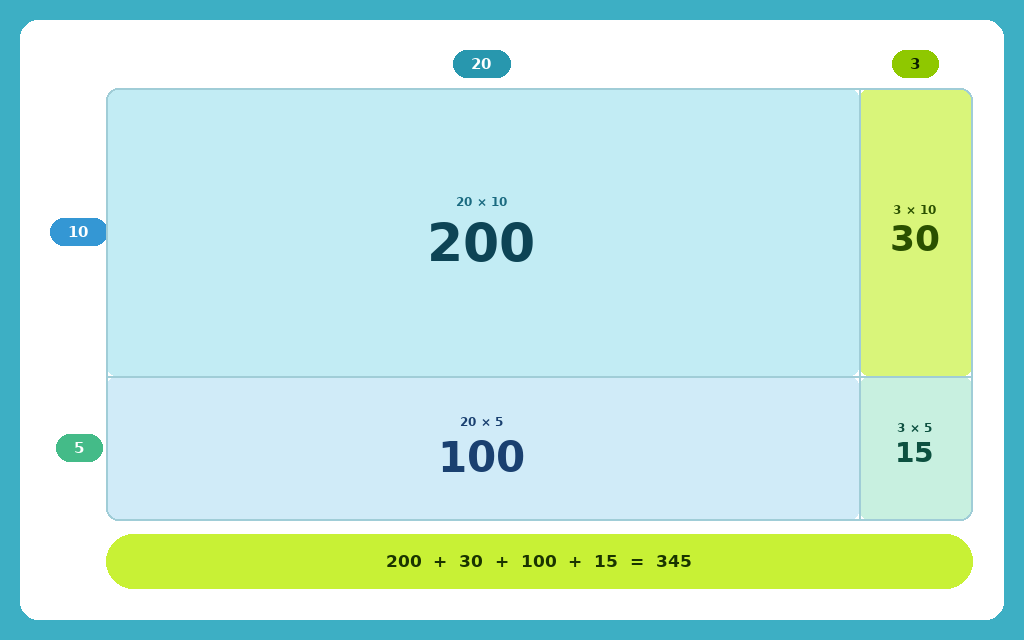
Now move to the kind of problem parents are more likely to see on homework: 23 × 15.
Break the numbers apart:
23 becomes 20 + 3
15 becomes 10 + 5
Now the rectangle has four boxes.² ⁴
Fill them in one at a time:
- 20 × 10 = 200
- 3 × 10 = 30
- 20 × 5 = 100
- 3 × 5 = 15
Now add all four partial products:
200 + 30 + 100 + 15 = 345
They’re showing the smaller multiplication problems that were already inside the bigger one.² ⁵
A Larger Area Model Example
The same pattern works when the numbers get bigger.
Take 7 × 345.
Break 345 into 300 + 40 + 5. Put 7 on one side and the three place value parts across the top. Now the rectangle has three sections instead of two or four.²⁵
Fill in each part:
- 7 × 300 = 2,100
- 7 × 40 = 280
- 7 × 5 = 35
Now add them:
2,100 + 280 + 35 = 2,415
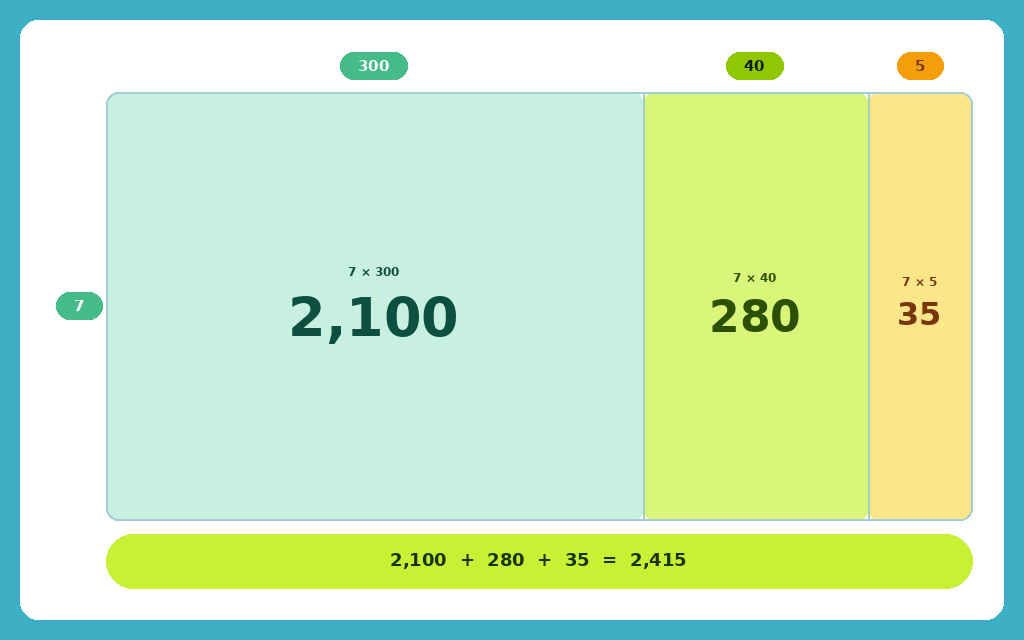
The structure stays the same — the number of sections just follows the place value parts.² ⁵
How the Area Model Connects to Place Value and Partial Products
This method only works if the numbers are being split by place value. That is why 23 becomes 20 + 3, not 2 + 3, and why 345 becomes 300 + 40 + 5, not 3 + 4 + 5.³ ⁵
Each box holds a partial product, which means one piece of the full answer.² ⁴ The standard algorithm uses these same pieces too. It just compresses them into a quicker written method.⁴ ⁷ The area model keeps them visible long enough for a child to understand what is happening.³ ⁵
If place value, multi-step math, or visual models have been repeated sticking points, it may also help to read Why Is My Child Struggling With Math.
What Grade Do Kids Learn the Area Model?
For most children in the U.S., the area model becomes a formal multiplication strategy in 4th grade.⁹
The groundwork often begins in 3rd grade, when children connect multiplication to area and start seeing how a rectangle can be split into parts.¹⁰ By 5th grade, they may use the same kind of model with larger multiplication problems and sometimes with division.¹¹
If your child is bringing home area model multiplication, fourth grade is usually when it arrives.⁹
Why the Area Model Can Feel Confusing at First
For many parents, this method feels unfamiliar because it is not how they learned multiplication.
It can also look longer than the method adults remember. Instead of one stacked problem, now there is a rectangle, several boxes, and an extra addition step at the end.
The extra steps are showing math the standard method usually hides.⁴ ⁷
How to Explain the Area Model to Your Child
Once you know what the boxes mean, you don’t need to re-teach the whole lesson. A useful goal at home is helping your child see what each part represents.
A few phrases that can help:
- “Let’s break the number into tens and ones first.”
- “Each box is one piece of the answer.”
- “Which number from the top meets which number on the side in this box?”
- “Now let’s add the pieces back together.”
It also helps to ask where they got stuck instead of restarting the whole problem. Sometimes the issue is not the entire method. Sometimes it is just breaking the number apart, knowing which pair to multiply, or remembering the final addition.³ ⁴
And one important note: if the teacher expects the area model, do not switch your child to the standard algorithm in the middle of homework just because it feels faster to you. That usually creates more confusion, not less.³
What does help is letting your child see that they already think this way outside of school.
For a broader breakdown of how to support math at home when your child gets stuck, read How to Help My Child With Math.
Talking Through the Area Model at Home
You do not need a lesson plan for this. Just look for moments where something big is already being split into smaller parts.
Four rows of 23 seats can be thought of as four rows of 20 seats and four rows of 3 seats. A rectangular room or garden bed can be measured in one larger section and one smaller leftover section. A tiled floor can be split into smaller rectangles and still make one whole shape.
Breaking a larger amount into smaller parts is normal thinking, not some strange school-only trick.
Common Mistakes Kids Make With Area Models
- Breaking numbers apart incorrectly: 243 should become 200 + 40 + 3, not 2 + 4 + 3.⁸
- Forgetting place value inside a box: If a box says 6 × 40, the answer is 240, not 24.⁴ ⁸
- Multiplying the wrong pair: Each box should combine one number from the top and one number from the side.² ⁴
- Missing a box: In a 2-by-2 model, all four boxes need an answer before the final addition.⁸
- Forgetting the final addition: Filling the boxes is not the last step. Those partial products still need to be added together.⁴ ⁸
Does the Area Model Only Work for Multiplication?
Later on, teachers may use a similar rectangle setup for division and, eventually, in some fraction or decimal work.¹¹ But if your child is seeing the area model in elementary homework, multiplication is still the most likely reason.⁹
Understand How Your Child Learns With Kidaro
Most of what you need for area model homework is in this article. But sometimes the difficulty isn’t the method — it’s how a particular child processes multi-step tasks, or how quickly they get overloaded when something looks unfamiliar.
If you want to understand that bigger picture more clearly, it may help to read How Do Children Learn Best.
Kidaro is designed to help parents understand how their child learns in a more specific, non-clinical way. It is not about labeling your child. It is about giving you a clearer picture of the patterns behind the struggle, so support at home can be more targeted and school conversations can be more useful.

Stop guessing what’s actually getting in the way.
FAQs
Sources
1. Methodwise. “What Is the Area Model? A Parent’s Guide.” Methodwise, 10 Mar. 2026.
2. Smartick. “How to Perform Multiplication Problems with an Area Model.” Smartick, 19 May 2022.
3. Shelley Gray Teaching. “What’s the Multiplication Area Model and How Do You Teach It?” Shelley Gray Teaching, 23 Nov. 2025.
4. Shelley Gray Teaching. “Using the Area Model for Multi-Digit Multiplication (Also Known as Box/Window Method).” Shelley Gray Teaching, 1 Feb. 2022.
5. Innovamat. “The Multiplication Area Model.” Innovamat, Feb. 2024.
6. BBC Bitesize. “Multiplication Using the Area Model.” BBC Bitesize, 2 Apr. 2025.
7. Mikey D Teach. “Teaching Multi-Digit Multiplication Strategies.” Mikey D Teach, 13 Jan. 2025.
8. Funexpected. “Error Patterns in Early Math: Common Mistakes.” Funexpected, 16 Apr. 2026.
9. “4.NBT.B.5.” Common Core State Standards Initiative, 2010.
10. “3.MD.C.7.” Common Core State Standards Initiative, 2010.
11. “5.NBT.B.6.” Education.com.
More for Parents:
- Learning Styles for Kids
- What Is My Child’s Learning Style
- Adaptive Learning for Kids
- How to Improve Working Memory in Children
- Working Memory Activities for Kids
- Executive Functioning Skills for Kids
- Emotional Regulation in Children
- Why Is My Child Struggling in School
- Why Is My Child Struggling With Reading
- How to Help My Child With Reading
- How to Motivate Kids to Study
- How to Reduce Procrastination in Kids
- What Makes Kids Hate School
- How to Help Children With Spelling
- Homework Support for Parents
- How Adaptive Learning Helps Kids
- How Kids Learn
- Bright Child Struggling at School

Written by
Kidaro Team