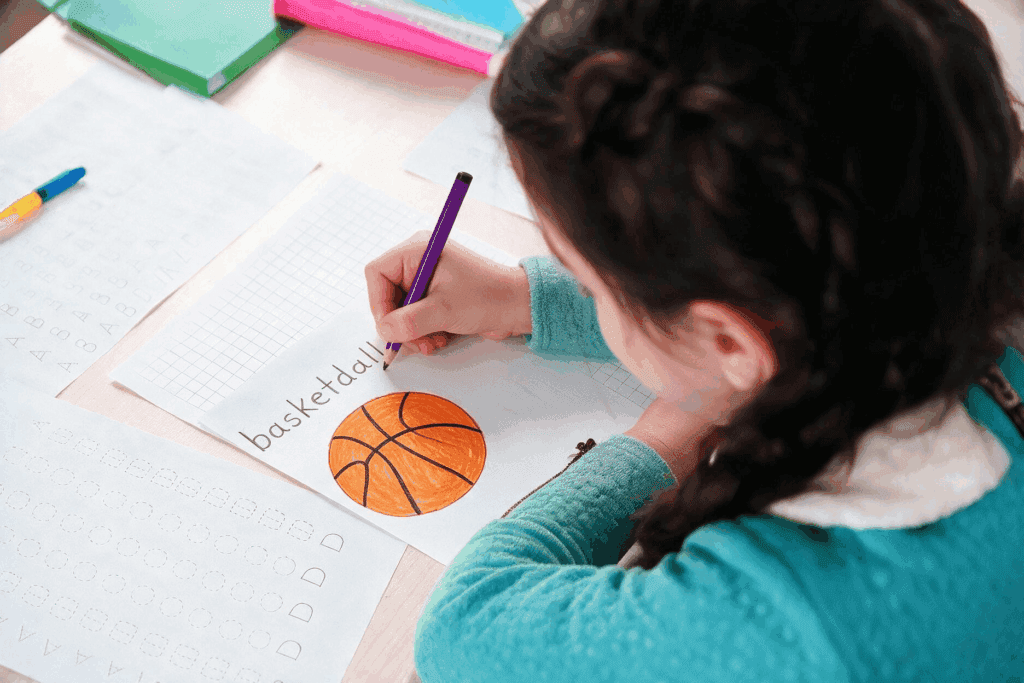


Your child spent forty minutes at the table with the flashcards out. Five minutes later, you ask a question and they blank. The time was there. The method wasn’t.
The best study tips for kids are less about making sessions longer and more about what happens during them. Recalling information, spreading practice across days, explaining ideas out loud, and checking what still needs work can make study time much more useful.
If getting your child to sit down and start is the bigger problem, our guide to How to Motivate Kids to Study Without a Fight covers that separately. Here, we’re focusing on what happens once they’re at the table.
Homework Isn’t Studying
Homework and studying can look like the same activity. They aren’t.
Homework is about completing assigned work. Studying is about what your child can recall, explain, or use without the answer in front of them.
That distinction matters because your child can finish every worksheet and still not be ready to recall the material later. The most useful study tips for kids start after the work is done: What actually stuck, and what still needs another look?
1. Give Each Study Session One Clear Target
Just telling your child, “Study science,” gives them very little to work with. “Explain the three stages of the water cycle without looking” gives the session a finish line.
Before they start, decide together what they should be able to do by the end. It could be recalling five vocabulary words, explaining one concept, or answering a short set of questions without help.
A clear target also makes it easier to stop. Once that goal feels solid, there is no need to keep drilling the same material just to fill another twenty minutes.
2. Study With the Book Closed
Looking at the same page again can make the material feel familiar. Closing the book is what shows whether your child can actually produce the information on their own.
After they review something, have them answer a question, explain the idea, or write down what they remember before looking back. Then check the answer and focus on whatever was missing.
This is one of the most useful study skills for kids because it changes studying from seeing the answer again to actually having to retrieve it. The effort is the point.
3. Spread Studying Across More Than One Day
A long session the night before a test can feel productive because everything is fresh. It usually gives your child fewer chances to pull that information back after some time has passed.
Instead, spread the review across a few shorter sessions. If a quiz is Friday, your child might review some of the material Tuesday, check it again Wednesday or Thursday, and use the final review for whatever is still shaky.
They do not need to start from zero each time. Coming back to the material after a gap gives them another chance to remember it instead of simply repeating what they just saw.
4. Find the Gaps Before Reviewing Everything
If your child has twenty terms to study, they probably do not need the same amount of practice on all twenty.
Before reviewing the whole list again, give them a few questions from the teacher’s study guide, workbook, or actual lesson material. Anything they miss, hesitate on, or cannot explain becomes the next place to focus.
It also helps to give your child some structure instead of simply saying, “Quiz yourself.” They may not always know which questions will actually show what they understand, so a short set of questions tied to the real material can give both of you a clearer picture.
5. Have Them Explain It in Their Own Words
Ask your child to explain what they learned without reading the answer back to you. Trying to put an idea into their own words often reveals the exact point where their understanding gets fuzzy.
They can explain it to you, a sibling, or even a stuffed animal. The audience is not the important part. Having to organize the idea well enough to explain it is.
You can make the prompt simple: “Teach this to me like I’ve never seen it before.” If they get stuck halfway through, you have just found the part worth reviewing.
6. Keep Phones Out of the Room, Not Just Face-Down
A phone does not need to be picked up to interrupt a study session. The sound or vibration of a notification can break concentration on its own.
And once your child’s attention shifts, getting fully back into the task is not instant. Five or six little interruptions can turn a short study session into a much more scattered one.
When possible, put the phone in another room on silent until the session is done. Face-down on the desk still leaves the next buzz close enough to pull their attention away.
Why “I Already Know This” Isn’t Always Reliable
Your child can genuinely feel ready and still struggle once the notes are gone. That does not automatically mean they were being careless or trying to get out of studying.
Part of the problem is that familiar material can feel learned. A page they have read three times looks recognizable, but recognizing the answer is easier than producing it without help.
That is why a quick check is usually more useful than arguing over whether they “know it.” Your job is not to catch them out. It is to help them compare how confident they feel with what they can actually recall, explain, or solve.
Over time, that becomes a study skill of its own: noticing what is secure, what is shaky, and what still needs another pass.
If you want the bigger picture behind why strategies like recall and spacing help, our guide to How Children Learn Best goes deeper into how learning and memory work together.
How Kidaro Helps
These habits give you a stronger starting point, but the same study routine can still break down in very different places.
Your child may have trouble getting started, lose track halfway through, rush through the check, or shut down as soon as something feels difficult. Those patterns can involve several parts of learning at once, including attention, working memory, motivation, pacing, and emotional comfort.
Kidaro’s Learning Profile helps you look at those patterns together and build a clearer picture of how your child approaches learning. It is non-clinical and does not diagnose or label your child.
The goal is not to find one perfect study method. It is to understand where support may be most useful so study time becomes less about guessing and more about responding to what you are actually seeing.

Stop guessing what’s actually getting in the way.
Sources:
- Karpicke, Jeffrey D., Janell R. Blunt, and Megan A. Smith. “Retrieval-Based Learning: Positive Effects of Retrieval Practice in Elementary School Children.” Frontiers in Psychology, vol. 7, 2016, article 350.
- Cepeda, Nicholas J., et al. “Distributed Practice in Verbal Recall Tasks: A Review and Quantitative Synthesis.” Psychological Bulletin, vol. 132, no. 3, 2006, pp. 354–380.
- Dunlosky, John, et al. “Improving Students’ Learning With Effective Learning Techniques: Promising Directions From Cognitive and Educational Psychology.” Psychological Science in the Public Interest, vol. 14, no. 1, 2013, pp. 4–58.
- Bisra, Kiran, et al. “Inducing Self-Explanation: A Meta-Analysis.” Educational Psychology Review, vol. 30, 2018, pp. 703–725.
- Finn, Bridgid, and Janet Metcalfe. “Overconfidence in Children’s Multi-Trial Judgments of Learning.” Learning and Instruction, vol. 32, 2014, pp. 1–9.
- Stothart, Cary, Ainsley Mitchum, and Courtney Yehnert. “The Attentional Cost of Receiving a Cell Phone Notification.” Journal of Experimental Psychology: Human Perception and Performance, vol. 41, no. 4, 2015, pp. 893–897.
More for Parents:
- How to Help a Child Struggling With Writing
- How to Address Procrastination in Kids
- Helping Kids Who Hate School
- How to Support Spelling at Home
- Helping Children With Schoolwork
- Executive Functioning Support for Children
- Learning That Adapts to Your Child
- What Research Says About How Kids Learn
- Bright Child Not Meeting Potential
- When Should a Child Be Able to Read?

Written by
Kidaro Team