
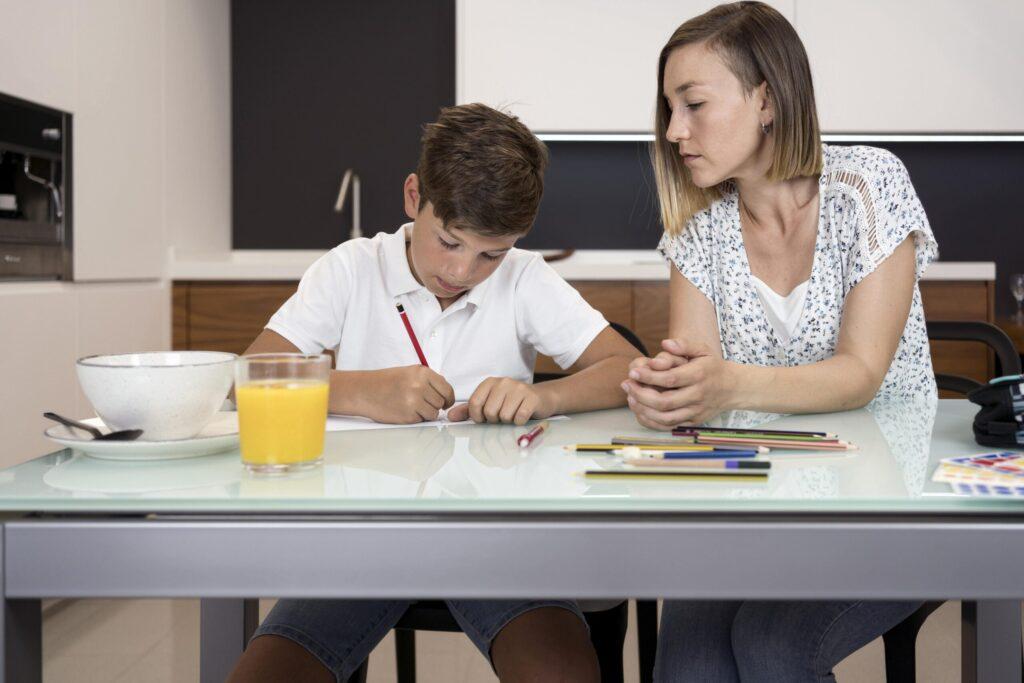
It’s not uncommon for parents to remind their child more than once to do their homework. Some parents even start thinking about that interaction on the way home from work. You get home, set your things down, ask how school went, and then, almost without thinking: “Did you get started on your homework?”
Then come the delays. The snack. The pencil sharpening. The half-open folder. The blank page that somehow still has nothing on it. When homework feels this hard to begin, one more reminder usually does not fix the problem. The work still needs to get done, but it may need to feel easier to start, easier to organize, easier to focus on, and easier to come back to when frustration hits.
If homework is part of a broader school pattern, you may also want to read: Why Is My Child Struggling in School?.
Make Homework Easier to Start
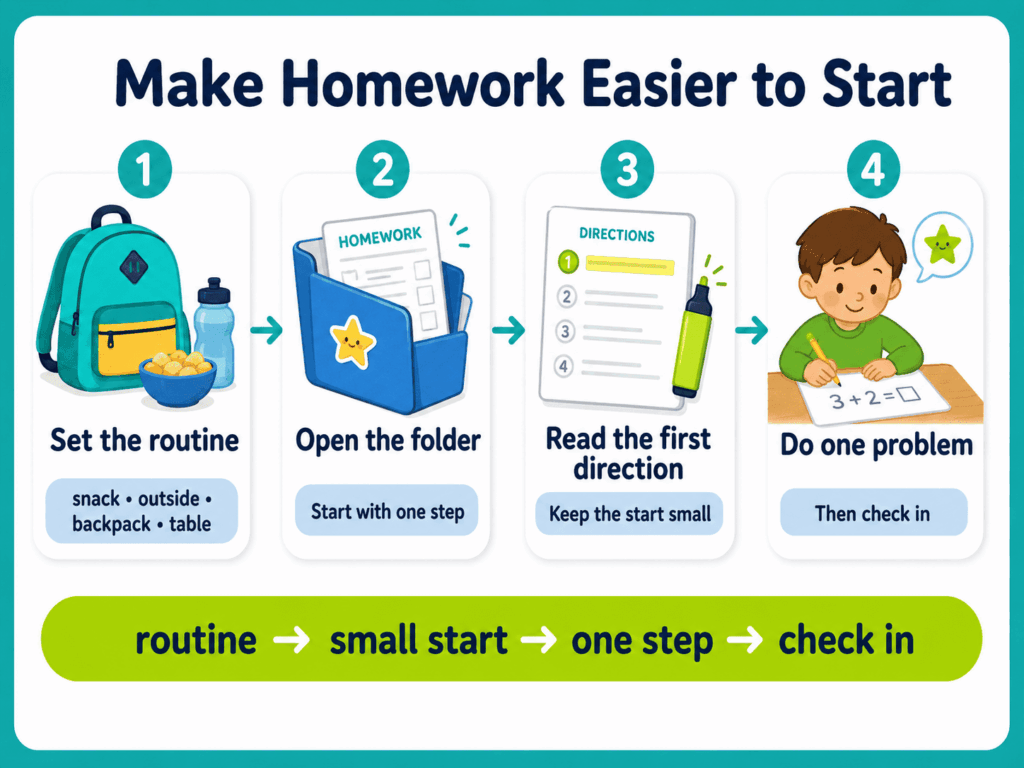
The first goal is not to finish the whole assignment. It is to make the start clear enough that your child can take one step.
A predictable start routine helps because it removes the same daily decisions: when to start, where to sit, and what happens first. Homework routines, consistent locations, daily schedules, breaks, choice, and simple incentive systems are all commonly recommended ways to make homework go more smoothly.¹
It does not have to be rigid. For one child, the routine might be:
- snack
- 15 minutes outside
- backpack unpacked
- homework folder opened at the table
For another child, homework may go better right after school while they are still in school mode. The exact routine matters less than having a clear pattern your child can expect.
The first step should also be small. “Go do your homework” can feel too big. “Open your folder and read the first direction out loud” gives your child a place to begin.
Other small starts might sound like:
- “Write your name and the date first.”
- “Do one problem, then we’ll check in.”
- “Circle the first question you want to try.”
- “Read the directions out loud before you start.”
- “Work for two minutes. You do not have to finish everything right now.”
Limited choices can help without making homework optional. Try asking, “Do you want to start with reading or math?” or “Do you want to do the easier one first or get the harder one out of the way?”
A small incentive can help when starting feels heavy, but keep it simple and predictable. “Homework first, then free time” usually works better than negotiating a new reward every night. The goal is to make the start feel lighter, not to turn homework into a nightly bargaining session.¹
If starting schoolwork is the main challenge, you may also find this helpful: how to motivate your kids.
Help Your Child Organize the Work Before Doing It
“Do your homework” can feel like one big, shapeless blob.
Your child may be looking at three assignments, unsure what is due tomorrow, missing a worksheet, and unable to tell which task will take five minutes and which one will take thirty. Before the work starts, it helps to make the work visible.
A simple homework map can do that.
A homework map is not a formal planner or a printable template. It is a quick two-minute conversation that helps your child see what is ahead. For children who struggle with working memory, breaking schoolwork into smaller parts, using routines, and relying on external tools like lists and reminders can help reduce the load of trying to hold everything in mind at once.²
| Question | Why it helps |
| What do I have to do tonight? | Makes the full picture visible |
| What comes first? | Reduces decision fatigue |
| What do I need before I sit down? | Prevents mid-task searching |
| Which part can I do alone? | Builds independence |
| Which part might need help? | Prevents panic later |
| How long might this take? | Builds time awareness |
This can sound very simple:
“What do you have tonight? What comes first? What do you need before you start?”
That brief pause helps turn a vague assignment pile into a sequence your child can actually follow.
Once the map exists, a checklist can keep things moving without constant reminders. Your child can check off one task at a time and see progress. That matters because homework often feels endless when the child cannot see what has already been finished.
You can also do a quick materials sweep before starting:
“Pencil? Folder? Book? Worksheet? Calculator?”
It sounds small, but it prevents the mid-task search that can completely break focus.
Support Focus Without Hovering
Focus during homework depends on more than willpower.
The length of the work block, the noise in the room, the phone nearby, the difficulty of the first task, and how tired your child is all affect whether attention is possible.
Shorter work blocks usually work better than long, open-ended sessions. For many elementary-age children, 10 to 20 minutes of focused work followed by a short movement break is more realistic than “sit here until it is done.” Understood notes that grade-schoolers often benefit from a break after about 10 to 15 minutes of work, while older students may be able to work longer before pausing.³
A visual timer can help because it makes time concrete. A child who can see, “I only need to work until the timer ends,” has a clearer target than a child who hears, “Just keep going.” Timers can also help children understand how much time is passing and what they can do within a set amount of time.³
A few setup changes can make focus easier:
Move devices away.
A phone or tablet nearby pulls attention even when your child is not using it. Try a simple rule: phones stay in another room until the work block is over.
Start with a quick win.
If your child is overwhelmed, begin with something they can finish quickly. One completed task can make the rest feel more doable.
Use movement breaks.
A break works better when it helps the body reset. Stretching, walking, getting water, or doing a few jumping jacks usually helps more than switching to a screen. Movement breaks can reduce stress and frustration, support focus, and help children return to the work more productively.³
Try body doubling.
Some children focus better when a parent is nearby. That does not mean watching every problem or correcting every sentence. It might mean sitting at the kitchen table with your own laptop, book, or paperwork while your child works nearby.
The difference is presence without control. A parent sitting nearby and doing their own work feels very different from a parent leaning over every few minutes to check answers. Research on parent homework help suggests that direct help does not automatically improve achievement, and that doing too much can interfere with children building the habits homework is meant to practice.⁴
If focus, follow-through, and organization keep showing up across homework and school routines, read our guide: Executive Functioning Skills for Kids.
Use Breaks, Choice, and Incentives Without Creating a Fight
Breaks, choices, and incentives can help. They can also backfire when they become avoidance, negotiation, or control.
The difference is structure.
A break is not the same as giving up. A good break lowers the emotional temperature and gives your child a clear path back to the work.
That means:
“Take five minutes, then we’ll come back to the first problem.”
Not:
“Take a break,” with no return plan.
Breaks should be short, clear, and easy to come back from. Movement, water, stretching, or a quick walk around the room usually works better than screen time, which can make returning harder.³
Choice works best when it is about the process, not the outcome. Homework still happens. Your child gets some say in how it happens.
For example:
- “Do you want to start with math or reading?”
- “Do you want a break after 15 minutes or after one page?”
- “Do you want to work at the table or the desk?”
- “Do you want me nearby or do you want to try the first part alone?”
These choices are small, but they reduce the feeling of being controlled. Child Mind’s NASP-based homework guidance also notes that building in choice around the order of assignments or the schedule can reduce power struggles.¹
Incentives can help too, especially around starting or persisting. But they should not become the reason for every pencil stroke.
A simple routine like “homework first, then free time” is often enough. “When the checklist is done, homework is done for the night” can also work because it gives your child a clear finish line.
What usually backfires is changing the reward every night, building a complicated point system no one can maintain, or turning every assignment into a negotiation.
The incentive should reduce friction. It should not become a new fight.
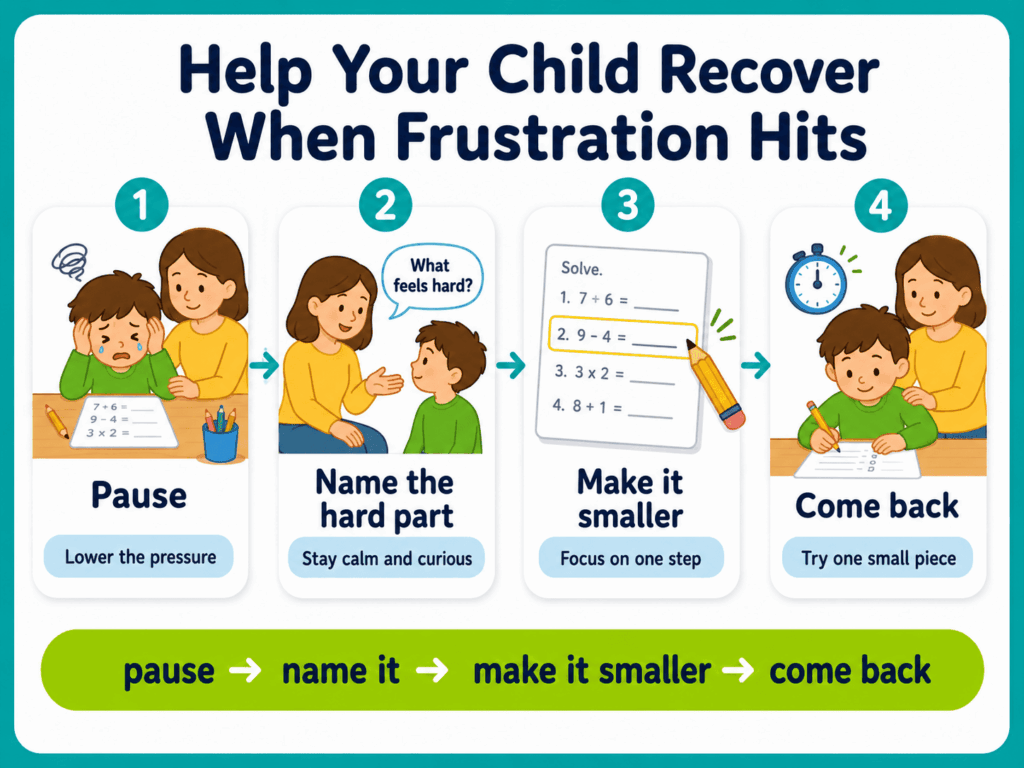
Help Your Child Recover When Frustration Hits
When a child cries, shuts down, refuses, or says, “I can’t do this,” the instinct is to push through. But once a child is escalated, more explaining usually does not land. Stress and homework anxiety can make it harder for children to stay motivated and engaged, especially when the home environment feels unpredictable or pressured.⁵
The goal is not to solve the whole assignment in that moment. It is to lower the emotional temperature, then return to one smaller piece.
Here are a few language shifts that can help:
| Instead of saying | Try saying |
| “Why haven’t you started?” | “What’s getting in the way right now?” |
| “Just try harder.” | “This part looks hard. Let’s find what’s making it tricky.” |
| “You know this already.” | “Something about this format is throwing you off. Let’s slow it down.” |
| “You can do this. Stop getting upset.” | “This feels hard right now. Let’s find the confusing part.” |
| “We’re not taking a break until this is done.” | “Take five minutes, then we’ll come back to the first problem.” |
If your child says, “I can’t do this,” try not to turn it into a debate. Start by making the task smaller: “Let’s just find the confusing part,” or “Let’s do the first step together, then you try the next one.” That moves the moment away from frustration and back toward one part of the work your child can handle.
If homework often turns emotional, this guide may help: Emotional Regulation in Children.
Know When Homework Struggles Point to a Bigger Pattern
Most children have rough homework weeks. A hard unit, a busy schedule, or a tired stretch can make homework harder for a while.
But if the same friction keeps showing up for weeks or months, it may be worth looking more closely at the pattern.
Pay attention if your child often:
- cannot start without heavy prompting
- loses folders, worksheets, or completed assignments
- forgets multi-step directions soon after hearing them
- gets overwhelmed quickly in the same subject
- takes much longer than expected to finish homework
- seems to struggle with reading, writing, or math in ways they cannot explain
- shuts down even when the assignment seems manageable
These signs are not proof of a learning difference. They are signals. They tell you that your child may need more specific support than another reminder, another routine, or another consequence.
That can be a good time to talk with the teacher. Child Mind Institute recommends asking the teacher what they are seeing at school, whether the same patterns show up in class, and whether school-based observation or additional support may be useful.⁶
Understand Your Child’s Learning Profile With Kidaro
If homework keeps breaking down in the same way despite trying different approaches, it can help to step back and look at how your child actually learns.
Kidaro is designed to help parents understand their child’s Learning Profile in a practical, non-clinical way. It is not about labeling your child or diagnosing anything. It is about making the patterns easier to see so support at home feels more specific and less like guessing.
When parents have a clearer picture of how their child processes information, organizes tasks, manages attention, or responds to frustration, they can ask better questions at school and set up more targeted support at home.
Learn more about our approach and how it can help you better support your child’s learning.

Stop guessing what’s actually getting in the way.
FAQs
Sources
- Child Mind Institute / National Association of School Psychologists, Peg Dawson, EdD, NCSP, “Strategies to Make Homework Go More Smoothly.” Last reviewed February 6, 2026.
- Child Mind Institute, Matthew Cruger, PhD, “How to Help Kids With Working Memory Issues.” Last reviewed March 25, 2026.
- Understood.org, Amanda Morin, “How Brain Breaks Can Help Kids With Homework Frustration.” Expert reviewed by Ellen Braaten, PhD.
- Penn State University, “Study Finds Parental Help With Homework Has No Impact on Student Achievement.” August 5, 2022.
- Li, Y. & Ding, W., “Influence of Parental Structure and Chaos on Homework Anxiety in Elementary School Students.” Frontiers in Psychology, 2024.
- Child Mind Institute, Michael Rosenthal, PhD, “How Do I Know If My Child Has Executive Function Issues?”
More for Parents:
- How to Help My Child With Math: A Parent’s Guide
- New Math vs Old Math: A Parent-Friendly Guide
- What Is the Area Model in Math? A Parent’s Guide
- How to Help My Child With Reading: A Parent’s Guide
- How Do Children Learn Best? A Parent’s Guide
- Procrastination Strategies for Kids
- Kids Hating School
- Help a Child Who Struggles With Spelling
- What Are Executive Functioning Skills
- Personalized Learning and Children
- How Your Child Learns Best
- When Smart Kids Don’t Do Well

Written by
Kidaro Team