

Most kids ages 7 to 10 do not refuse to study because they are lazy or careless. They stall, argue, or melt down because the whole thing can feel overwhelming before it even starts. By that point, the argument is usually not really about the worksheet anymore. It is about the feeling that the whole thing is too much.
The most effective approach combines a predictable routine, a distraction-free space, and a way of showing up that keeps your child involved rather than managed. Most advice focuses on the child. Often, the bigger lever is how the session is set up.
If the struggle feels bigger than a rough night, Why Is My Child Struggling in School? is worth a look.
Make Studying a Daily Routine
Pick a time and a spot. Use both as consistently as you can. When studying usually happens in the same place and around the same time, your child has one less decision to make before starting. That matters, because starting is often the hardest part.
It does not have to be right after school. Some kids need a snack first, or twenty minutes to run around. That still works. What matters is that the routine feels predictable, not that it happens immediately.¹
Set Up a Study Space That Works
The environment matters more than most parents realize. A few things can make studying feel less scattered from the start:
- Natural light when possible. Try to schedule study time before sunset.
- Background TV and music off. A fan or white noise is fine.
- Clear the desk down to only what is needed for that task.
- Keep phones and tablets out of the room when possible. Even when they are silenced or turned face-down, they can still pull attention away from the task.²
The right space does not guarantee focus, but the wrong one can make studying much harder than it needs to be.
Let Your Child Help Plan the Study Session
Before anything opens, spend two minutes making a list together. What needs to get done? In what order? How long will each thing take? Let your child weigh in, whether it is homework, test prep, or reading practice.
Keep the session to 20 to 40 minutes. Beyond 45 minutes, attention and mood usually start to drop for this age group.³ If there is genuinely more to do, a short break and a second session usually works better than one long slog.
Start With Something Easy
Once the list is made, the order matters more than parents usually think. Do not save the easiest task for last. Start there.
Easy-to-hard ordering builds momentum, and if a child hits a wall in the first ten minutes, the rest of the session is uphill. A small win early changes the whole tone. Motivation often shows up after a child feels some momentum, not before.
Use a Simple Progress Tracker
A checklist drawn before the session starts. A paper progress bar they fill in. Crossing things off a list. It sounds low-tech because it is, but seeing the endpoint of a task and watching it get closer keeps attention going in a way that staring at an open page does not.
It also helps kids who struggle with planning and follow-through stay oriented. How to Improve Working Memory in Children goes deeper on that if it sounds familiar.
Watch for a Few Minutes Before Helping
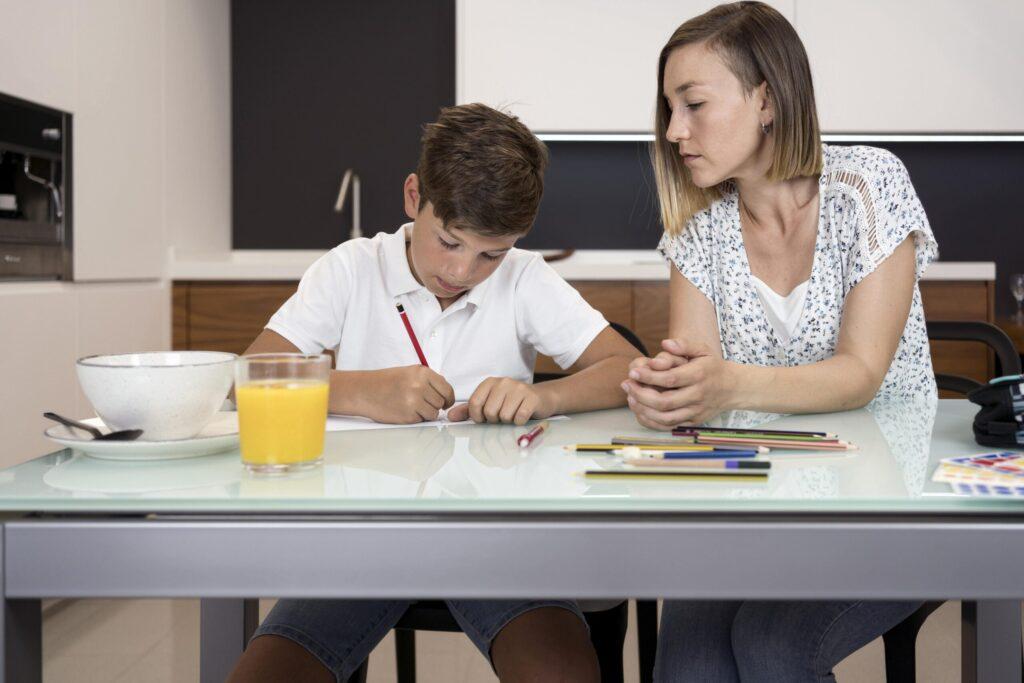
Once the session starts, the instinct is usually to help right away. That makes sense, especially if you can already see where the mistake is coming. But jumping in too quickly can make a child feel watched, corrected, or rushed before they have had a chance to think.
Spend the first few minutes just observing. Notice your child’s mood, their energy, and whether they actually understand what they are looking at. That pause gives you a better read on what is happening, and it gives your child a little more room to start on their own.⁴
How to Help Your Child Study Without Taking Over
When you do step in, ask first. “Do you want me to help, or do you want to try it yourself?” Use questions instead of answers. “What do you already know about this?” usually gets further than “here’s how you do it.”
When parents routinely solve the problem, kids gradually stop working through difficulty on their own.⁵ The goal is not to leave them stuck. It is to help without taking over the thinking.
Small shifts in wording can change the whole feeling of the session:
| Instead of saying | Try saying |
| “You have to do it this way.” | “How do you want to tackle this?” |
| “Just focus, stop complaining.” | “It’s frustrating, I can see that. What’s making this hard?” |
| “Practice your spelling because it’s on the test.” | “Practice your spelling so you can write those stories you’re always making up.” |
The second version in each pair connects to your child’s interests and keeps them feeling like a participant.⁶ Phrases like “you have to” and “because I said so” can make a child feel like their judgment does not count here. Many kids shut down when they feel managed instead of involved.
On praise: “good job” does not always land. What works better is naming the specific thing you noticed.
- Instead of “You’re so smart!” try “I noticed you kept trying even when that problem was tricky.”
- Instead of “Great job!” try “You just reread that sentence to make sure you understood it. That’s what strong readers do.”
- Instead of “You got it right!” try “What strategy did you use to figure that out?”
Keep it honest and proportional. “That was hard and you stuck with it” is more useful than “incredible.”⁷
Should You Reward Your Child for Studying?
Rewards can help when the goal is starting something your child genuinely dislikes. They are less useful when your child already has some interest in the activity, and they tend to backfire when tied to grades or test scores.⁸ If you use them, plan to fade them after a couple of weeks and see what holds.
Your State Matters Too
One last thing: your state matters. If you’re stressed or running out of patience, your child can usually feel it, even when you’re saying the right words. Kids this age are tuned into the emotional temperature of a room in ways that often surprise parents. Your tone, your body language, the way you respond when something goes wrong — all of it is part of their experience of the session. You don’t have to be endlessly patient. You just have to notice when you’re depleted before you walk in. Emotional Regulation in Children has more on this.
When Study Battles Keep Coming Back
Everything here can help. But if the same struggle keeps showing up week after week, the issue may not be motivation alone. Some kids get stuck because of how they process instructions, manage frustration, or hold multiple steps in mind at once.
That is not a discipline problem. It is a pattern. That’s why understanding Executive Functioning Skills for Kids can help you see where the friction is actually coming from.
If study time keeps turning into the same fight, another generic strategy may not be enough. You may need a clearer read on what is making the work feel so hard to begin with.
Kidaro helps parents understand how their child learns, focuses, and handles schoolwork, so support at home can become more specific. It is not a diagnosis. It is not a label. It is a clearer way to see what is going on.

Stop guessing what’s actually getting in the way.
Sources
- Child Mind Institute (2026). Strategies to make homework go more smoothly.
- Ward, A. F., et al. (2017). Brain drain: The mere presence of one’s own smartphone reduces available cognitive capacity. Journal of the Association for Consumer Research.
- Frontiers in Psychology (2025). What length of after-school learning time best promotes non-cognitive ability development?
- Hebrew University of Jerusalem (2024). Parental mentalization, emotional regulation, and homework quality. Journal of Educational Psychology.
- Grolnick, W. S., & Pomerantz, E. M. (2022). Should parents be involved in their children’s schooling? Theory into Practice.
- Gordeeva, T. O., Nechaeva, T. A., & Sychev, O. A. (2025). Parental autonomy support and homework motivation. Psychology in Russia: State of the Art.
- Frontiers in Education (2024). Student-delivered behavior-specific praise: A systematic literature review.
- Bardach, L., & Murayama, K. (2025). The role of rewards in motivation: beyond dichotomies. Learning and Instruction.
More for Parents:
- How Do Children Learn Best? A Parent Guide
- Learning Styles for Kids: What VARK Gets Right and What Actually Helps
- Working Memory Activities for Kids
- What Is My Child’s Learning Style?
- Why Kids Procrastinate
- Why Does My Kid Hate School?
- Help Your Child With Spelling
- Homework Help for Parents
- Executive Functioning in Kids
- Personalized Learning for Children
- Smart Kids Who Struggle

Written by
Kidaro Team