
You noticed it before the teacher said anything. Maybe it was grades dropping on work, you know, they understood. Maybe it was the Sunday-night dread starting up again, stomachaches before school, fights at the door every morning, homework that takes three times as long as it should. Or maybe your child seems to get it in class and then goes blank on the test.
You keep thinking: I know they’re bright. So what’s going on?
Knowing they’re capable makes the confusion worse, not better.
You’re not the only parent sitting with this, and you haven’t missed something obvious. The answer is rarely the first thing you land on. There’s usually not one clean answer. It can come from school, from home, from how they’re feeling physically, or from how things fall apart when the pressure is on. It’s rarely just one thing.1 Most of the time, it is not one problem, but how several factors combine and show up under pressure.
Most parents go looking for one clean reason. The reality is usually messier, and it usually takes a few tries to see what’s actually driving it.1
What Can Cause a Child to Struggle in School?
Learning and Attention Problems
For some kids, the struggle starts with the basics of learning. Reading, writing, math, or processing language can take more effort. That is not a sign that they are not smart. It means learning just takes more out of them, so they hit a wall faster.
That being said, being able to pay attention for long periods of time is its own problem. Some kids can track the teacher’s explanation, then hit a wall five minutes later when they have to do it alone. That is why it looks different at home than it does at school.3
Helpful tip: Have a quick conversation with your child’s teacher and ask where things start to break down, during the lesson, during practice, or only when your child has to work independently. That one detail often tells you what kind of support will actually help.
Not every wall is about ability. Some of them are about how a kid feels walking in.
Emotional and Social Struggles
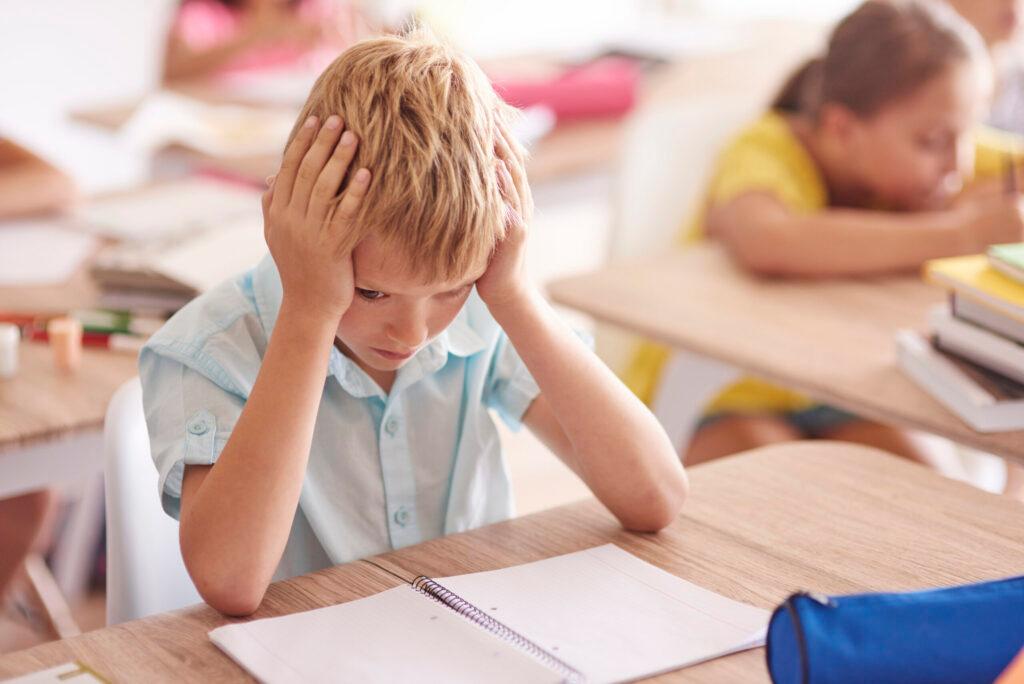
A lot of parents go straight to academics here, but pressure is usually what is driving the struggle. Anxiety can show up as freezing on tests, skipping participation, or just never starting the work. Some kids also show it physically. Stomachaches and headaches that cluster around school days are not always random.2
Social stress can be just as disruptive. Feeling safe at school matters more than most people realize. If your child is dealing with bullying, exclusion, or constant social tension, their head is somewhere else entirely. Stress at home follows kids to school, too. Family conflict, grief, or major changes can quietly chip away at school even when they cannot name why.1
Looks like not caring. Usually it isn’t.
Helpful tip: Skip the big question, “How was school?” Ask something easier: “When did your day start feeling bad?” and “Who did you feel okay around today?” Those two answers tell you more than most homework conversations ever will.
It sounds basic, but sleep and health quietly affect everything else on this list.1
For more on what happens when frustration disrupts thinking and performance, read Emotional Regulation in Children.
Sleep, Health, and Physical Factors
Sleep affects more than most parents expect. When kids are tired, you usually see more distractibility, quicker to lose it, and less ability to push through frustration. Everything takes more out of them, including the easy stuff.
Health issues can create the same pattern. Recurring headaches, stomachaches, fatigue, chronic pain, asthma flares, or frequent illness can make a kid look like they stopped caring, when the truth is they are already worn out before the first period starts.
What to do with this: If school-day mornings look rough, start with sleep and health first, including vision and hearing if you have not checked recently.1
The Less Visible Skills That Can Affect School
Sometimes the outside stuff is fine, and the inside stuff is the story.
This is the part many parents do not see right away. Sometimes the content is not too hard. The process is. School expects kids to remember steps, manage distractions, get started, stay organized, and keep going when things get frustrating.3
If you want a broader look at the skills behind planning, starting, and following through, read Executive Functioning Skills for Kids.
What to do with this: Watch for where the chain snaps, remembering steps, getting started, staying on track, or recovering after frustration hits.3
Here is the part that makes it genuinely hard to pin down.
A note on overlap: These things pile on top of each other more than people realize. Anxiety can make organization worse. Poor sleep can make attention and emotional readiness worse. Bullying can hit confidence and school engagement at the same time. That is part of why things can seem fine one week and off the next.4
There is a shorter list underneath all of this, and it is worth knowing.1,2,3,4
What Skills Affect School Performance?
If the broad causes don’t fully explain what you’re seeing, these four skills are often the missing piece.5
- Working memory: holding instructions and steps in mind while doing the task
- Attention control: staying with the task and shifting when needed without losing the thread
- Executive function: planning, starting, organizing, managing time, and following through
- Emotional readiness: staying regulated enough to think, recover from mistakes, and keep going
When these skills are supporting learning, school feels more manageable. When one is strained, a child can struggle even when they’re capable.5
If that pattern sounds familiar, read How to Improve Working Memory in Children for a closer look at one of the most common learning bottlenecks.
What This Can Look Like in Everyday School Life
- Anxiety/school stress: your child studies fine, then blanks on tests, avoids participation, or melts down before school.2
- Social stress: school starts feeling heavy, motivation drops, and your child doesn’t want to explain why.1
- Poor sleep/health strain: more irritability, more tears over small things, less stamina for homework.1
- Working memory strain: understands the lesson, then forgets steps mid-assignment, or can’t follow multi-step directions.5
- Attention control strain: drifts, misses details, starts tasks, and doesn’t finish, especially during independent work.5
- Executive function strain: good ideas, weak follow-through, procrastination, messy materials, missing assignments, “I don’t know where to start.”3
- Emotional regulation strain: one mistake flips the switch, frustration takes over, and the work stops.2
If your child looks capable in some moments and falls apart in others, that inconsistency is often information, not attitude.
If getting started is often the hardest part, read how to motivate kids.
What Parents Can Look At First
Before you lock onto one explanation, slow down and look at the pattern.
Start with the big external drivers
- Has sleep gotten worse lately?
- Is school triggering anxiety or avoidance?
- Any signs of bullying or peer stress?
- Are headaches, stomachaches, or fatigue showing up around school?
- Has anything changed at home that could be spilling into school?1
Then check where learning breaks down
- Working memory: Do they forget steps right after you say them?
- Attention control: Do they lose the thread even when trying?
- Executive function: Are they stuck on starting/organizing more than understanding?
- Emotional readiness: Does one mistake derail the whole task?3,5
One high-leverage question for the teacher:
“Do they understand the lesson but struggle during independent work or assessments?”
That gap is often where the real answer sits.1
When to Consider Extra Support for School Struggles
Not every struggling child has a diagnosable issue. But if the same problems keep showing up, and nobody can clearly explain why, it may be time to bring in extra help.
Consider outside support if you’re seeing persistent signs of:
- ADHD or major attention issues
- significant anxiety, school avoidance, or stress symptoms
- bullying or fear of school
- learning disabilities (reading, writing, math)
- ongoing health symptoms tied to school days
- emotional distress that’s escalating over time
Start with teachers and your pediatrician. If the pattern persists, a school psychologist, therapist, neuropsychologist, or learning specialist can help clarify what’s going on.6
Some kids fall into a middle space: clearly struggling, but nothing “clean” explains it. That’s where parents often need a better framework than guessing.6
Understanding Your Child’s Learning Profile
School struggles rarely come from one place. A child may be bright and trying, but still have trouble with working memory, attention, organization, frustration, or confidence when the pressure rises.
Kidaro is built around that middle space: when your child is capable, but the usual explanations do not fully explain what you are seeing.
A Learning Profile is not a diagnosis.
It is not an IQ test.
It is not a label.
It is a clearer way to understand how your child learns, where things may be getting stuck, and what kind of support may actually help.

Stop guessing what’s actually getting in the way.
FAQs
Sources
- Child Mind Institute. (Reviewed Nov 7, 2025). How to Support Young Kids Who Are Struggling in School.
- Child Mind Institute. (Reviewed Nov 10, 2025). How Anxiety Affects Kids in School.
- Child Mind Institute. (Reviewed Jun 5, 2025). Helping Kids Who Struggle With Executive Functions.
- Du, H., Lv, J., Sun, Y., & An, X. (2024). The longitudinal relations between executive function and academic and social development in children.
- Spiegel, J. A., et al. (2021). The relation between executive functions and academic achievement: A meta-analysis.
- Child Mind Institute. (Reviewed Aug 6, 2025). Help for Kids Struggling With Learning.
More for Parents:
- How Do Children Learn Best? A Parent Guide to What Actually Helps
- Adaptive Learning for Kids: What It Is and What Real Personalization Requires
- Working Memory Activities for Kids
- What Is My Child’s Learning Style?
- Learning Styles for Kids: What VARK Gets Right and What Actually Helps
- How to Reduce Procrastination in Kids
- Why Kids Hate School
- Help Kids With Spelling
- Help Kids With Homework
- Smart Child Struggling in School
- What Age Should a Child Read?

Written by
Kidaro Team