

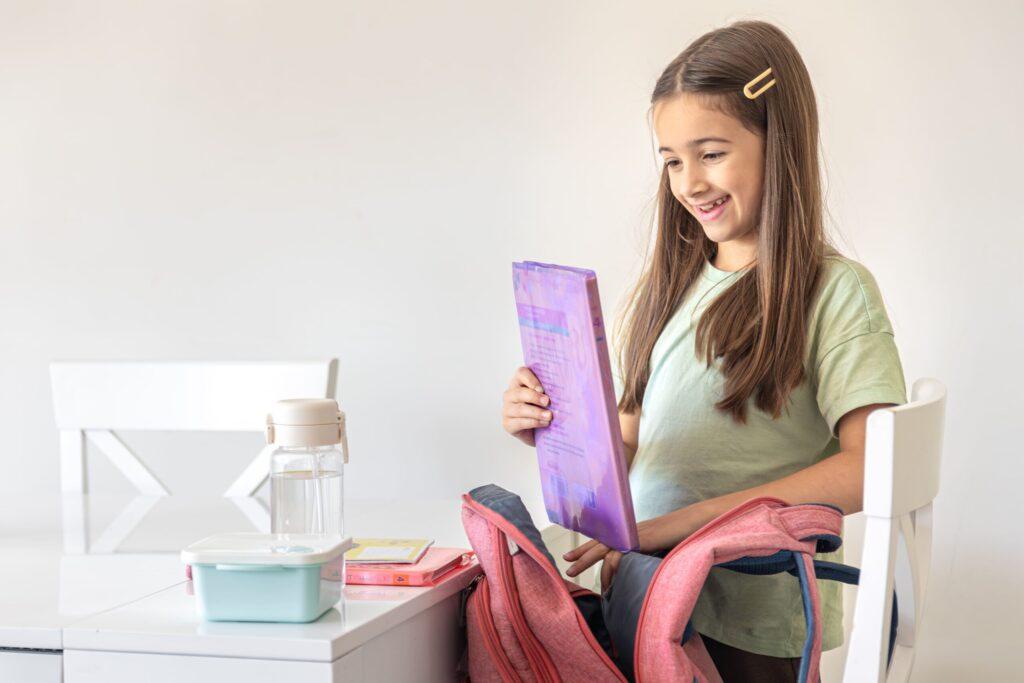
You remind them the night before…and when you check their backpack in the morning, nothing’s been organized, and you end up packing it for them. Maybe you’ve driven a forgotten folder to school more than once, and you swore you wouldn’t do it again. But, no matter how many times you tell them, nothing actually sticks.
A lot of parents respond to disorganization by adding more reminders. But reminders are fragile. They depend on your child hearing it, holding it in mind, and acting on it at the right moment. But here’s the thing: organization isn’t a personality trait your child either has or doesn’t. It’s a skill, and it develops with the right systems in place, and a simple system is much more effective because it stays visible even after the reminder is gone.⁴ ⁵
Here are 6 helpful tips that can help you create a simple system to sharpen your kid’s organizational skills.
1. Set Up a Launch Pad by the Door
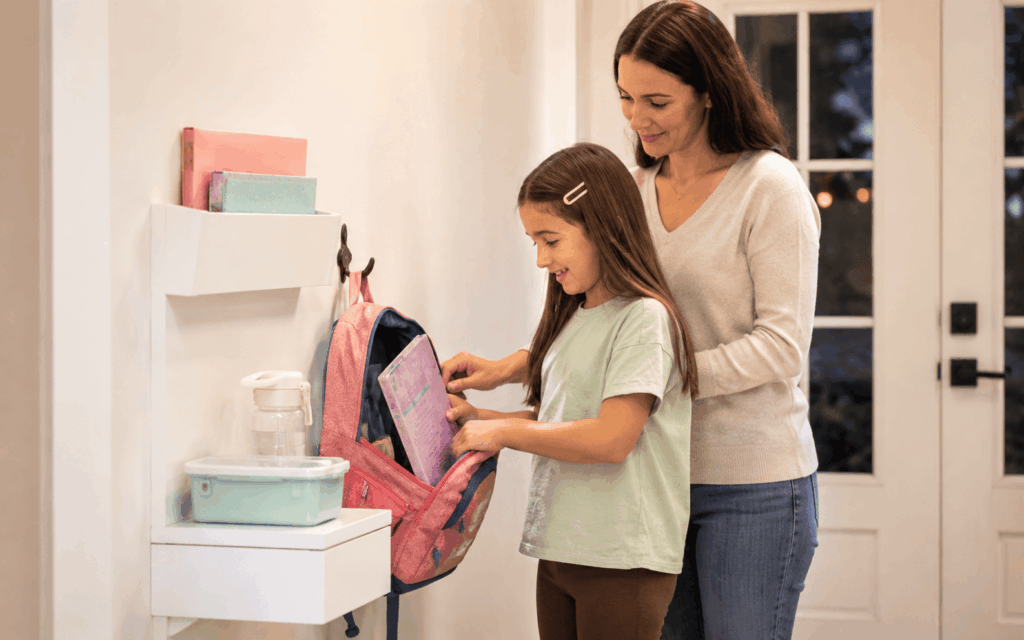
Pick a spot near the door your child actually uses, not the tidy corner by the garage that makes sense on a floor plan. A hook for the backpack, a tray or bin for papers and permission slips, and a dedicated spot for the lunch box and water bottle. That’s the whole setup.
The rule is simple: everything school-related lives here and only here. Backpack goes here. Library book goes here. The signed field trip form goes here the moment it comes home.
When things have a fixed home, your child stops having to remember where they put stuff. The system does the remembering instead.
2. Build a Nightly Backpack Reset
Ten minutes, same time every night, anchored to something that already happens. Right after dinner. Right before screen time. Whatever already exists in your routine.
Open the backpack together, pull out any loose papers, restock whatever got used up, and make sure the folder and anything needed for tomorrow are already inside.
This isn’t about homework. It’s not about studying. It’s only about the tangible elements: making sure tomorrow morning’s backpack is already done before anyone goes to bed.
When the decisions are made the night before, the morning stops being a scramble. There’s nothing to find because everything’s already there.
3. Use a “What Do I Need?” Checklist
A short written checklist, posted at the launch pad or tucked inside the front pocket of the backpack. Three to five items at most: folder, books, any signed papers, lunch, water bottle.
Have your child help you write it. Not because it’s a cute craft project, but because a checklist they made themselves is a checklist they’ll actually look at.
Written beats verbal every time at this age. A verbal reminder disappears the moment you say it. A written list is still there when your child is standing at the door.
Keep it process-specific: “Did the folder go in the backpack?” works better than “Did you pack everything?” One is a check. The other is a guess.
4. Color-Code the School Stuff That Gets Mixed Up
Give each subject a color. Math is blue, reading is green, science is yellow, or whatever your child picks. The matching folder and notebook go in that color. That’s it.
When everything has a color, sorting becomes instant. Your child doesn’t have to read the label or think about it. They just match.
Keep a brightly colored pocket folder, ideally one that stands out from the rest, for anything that needs a parent signature and needs to come back to school. Red works well. The goal is that it never gets buried.
Color-coding works because it removes one small decision your child would otherwise have to make over and over: “Which folder does this go in?”
5. Let Your Kid Pick the System
You set the options. They choose.
Binder or separate folders? Hook or a shelf? A paper checklist on the wall or a small whiteboard? Present two or three real options and let your child decide. Kids who help design the system are far more likely to actually use it, because it feels like theirs instead of something imposed on them.¹ ²
Once you’ve set it up together, hand it over gradually. The first few days, do the backpack reset together. Then let them run through it while you’re nearby. Then check in after. The progression matters: first you show, then you do it together, then you watch, then you step back.³
If the system isn’t perfect, don’t overhaul it. Adjust one piece at a time. Ownership is the goal, not a flawless setup.
6. Start With One Change and Give It Two Weeks
Don’t set up a launch pad, build a checklist, color-code all the folders, and reorganize the backpack in one weekend. Pick one thing, commit to it for a few weeks, and only then add the next.
Systems need time to turn into habits. When you change everything at once, nothing gets a chance to stick. Start small so your child has one clear routine to practice, not five new rules to remember.
A few weeks on one change. Then you’ll actually know if it’s working.
If the issue is less about losing materials and more about avoiding the work altogether, How to Reduce Procrastination in Kids looks at that pattern specifically.
When It’s More Than a Messy Backpack
If disorganization is one piece of a bigger pattern, understanding how your child learns can help you support them more clearly. That’s especially true if you’re also seeing trouble starting tasks, difficulty with multi-step directions, or instructions that seem to vanish the moment you say them.
If organization is part of a broader school pattern, Why Is My Child Struggling in School? may also help.
Kidaro maps your child’s Learning Profile across areas like planning, attention, memory, and motivation. Join early access at kidaro.app.

Stop guessing what’s actually getting in the way.
FAQs
Sources
- Obradović, J. et al. “Learning to Let Go: Parental Over-Engagement Predicts Poorer Self-Regulation in Kindergarteners.” Journal of Family Psychology, 35(7), 2021.
- Meuwissen, A.S. & Carlson, S.M. “Parent Provision of Choice Is a Key Component of Autonomy Support in Predicting Child Executive Function Skills.” Frontiers in Psychology, 12, 2022.
- Cleveland Clinic. “What Is Scaffolding? Child Development Strategy Explained.” Reviewed by Dr. Kathryn Katz, pediatric psychologist, 2025.
- Abikoff, H., Gallagher, R., Wells, K.C. et al. “Remediating Organizational Functioning in Children With ADHD: Immediate and Long-Term Effects From a Randomized Controlled Trial.” Journal of Consulting and Clinical Psychology, 81(1), 2013.
- Rosenblau, G. et al. “A Canonical Trajectory of Executive Function Maturation from Adolescence to Adulthood.” Nature Communications, 2023.
More for Parents:
- Executive Functioning Skills for Kids
- Working Memory Activities for Kids
- How to Help Your Child With Homework
- Smart Child Struggling in School? What to Know
- How to Motivate Kids
- Tackle Procrastination in Kids
- What to Do When Your Kid Hates School
- Building Spelling Skills in Kids
- How to Manage Homework at Home
- Executive Functioning Help for Kids
- Personalized Education for Kids
- What Works for Kids’ Learning
- Child Is Intelligent but Struggling

Written by
Kidaro Team