

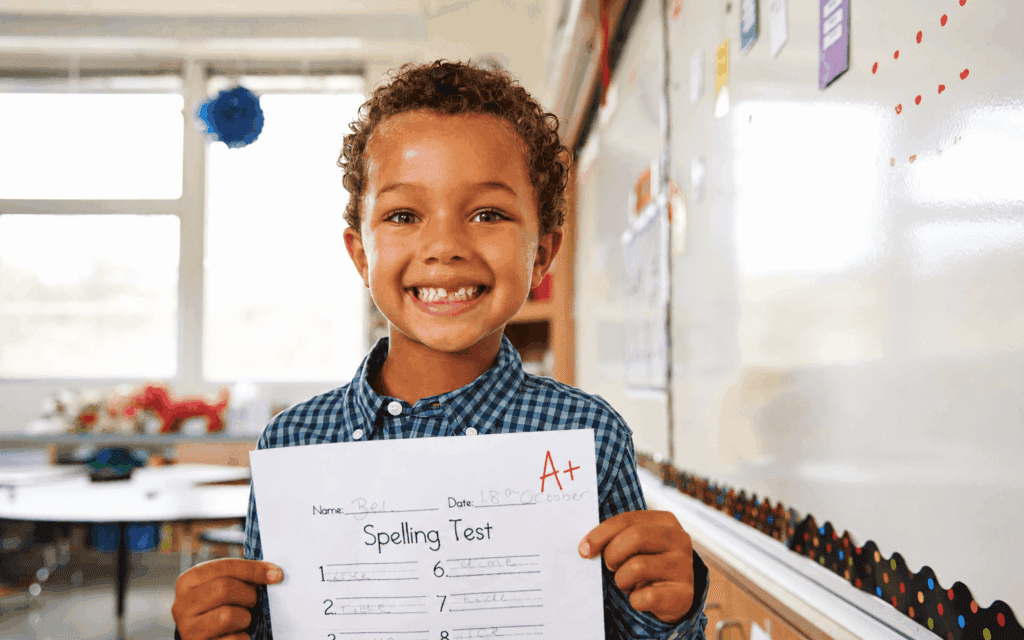
Your first grader writes “sed” for said. Your second grader writes “rane” for rain. And while they both are misspelling words, they’re each making completely different kinds of mistakes, and what helps one won’t automatically help the other. Once you know what kind of mistake your child is making, practice at home can be more targeted and a lot shorter.
In this guide, we’ll break down how spelling changes from first to second grade, what you can do at home to help, and when errors may be worth a closer look.
What’s Happening at Each Grade
In first grade (ages 6–7), kids are learning that letters map to sounds. They’re building accuracy with short words like cat, sit, and hop, learning common letter combinations like sh, ch, and th, and starting to handle beginning blends. For example, when your child writes “wuz” for was or “hv” for have, they’re spelling what they hear. They’re using what they know about sounds, even when the word doesn’t follow the pattern they expect. It’s not a failure; it’s a starting point. By the end of first grade, most kids can spell short-vowel words reliably and are just starting to see how silent-e patterns work.¹
In second grade (ages 7–8), the game changes. Your child moves from matching letters to sounds, one at a time, to recognizing that English spelling runs on patterns. They’re working on vowel teams like ai/ay and ee/ea, r-controlled vowels like girl, park, and turn, and beginning to handle simple prefixes, suffixes, and contractions. One good sign: your child pauses mid-word and asks, “Does that look right?” They’re checking spelling against memory, not just sound.
A first grader needs help hearing sounds. A second grader needs help seeing patterns.²
Strategies That Match Each Grade
Sound Mapping (First Grade Focus)
Use this when your child is leaving out sounds or simplifying words, writing “pln” for plan or “fat” for flat.
Draw a row of boxes, one box for each sound in the word, not each letter. Ask your child to say the word slowly and write the letter or letters for each sound in its own box. For example, the word ship would have three boxes: one for sh, one for i, and one for p. Once your child has mapped the word, have them write it once without the boxes.³ That helps you see whether they can carry the sounds into normal writing.
If they miss a sound, say the word together slowly and try that part again.
Word Sorts (Second Grade Focus)
Use this when your child knows the sounds but gets the pattern wrong, writing “trane” for train or “dai” for day.
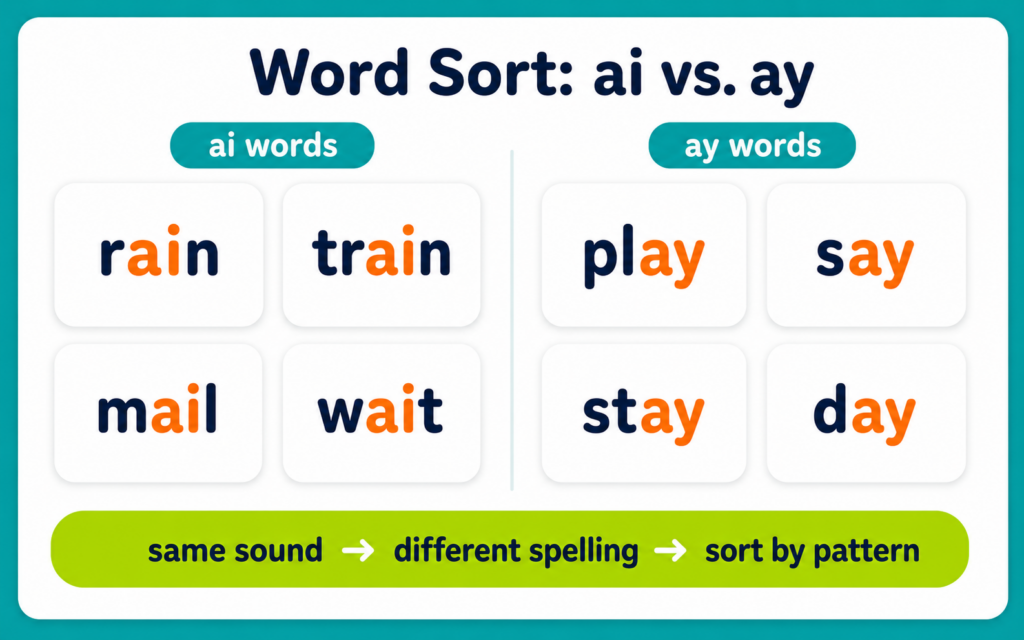
A word sort means exactly what it sounds like: you write a set of words on index cards and your child sorts them into columns by spelling pattern. Use 8 to 10 words across two spelling patterns. For example, label two columns “ai words” and “ay words.” Rain, train, and mail go in one column. Play, say, and stay go in another. The point is not memorizing. It is helping your child notice which words follow the same spelling pattern.
After sorting, have your child look for words with those same patterns in a book they’re already reading. That connects the pattern to real reading, not just a card exercise.
Cover-Write-Check (Both Grades)
Use this for sight words that can’t be sounded out: was, come, friend, they. These words do not follow the sound rules your child is learning, so sounding them out usually will not help. They need to be learned by sight.
The method is simple: look at the word, say it, cover it, write it from memory, then check it. If it’s wrong, don’t just have your child try again right away. Look at the specific part that tripped them up, then cover and try once more. Come back to that word the next day. The important part is checking the mistake, not repeating the word over and over without noticing what changed.
For full walkthroughs of word sorts and cover-write-check with step-by-step examples, see How to Help Kids With Spelling.
Keep all of this to about five words at a time. Short, steady practice usually helps more than one long push on the weekend.⁴
Spelling Errors by Grade: What’s Normal and What’s Worth Watching
Most spelling errors in first and second grade are completely expected. Knowing which ones are normal makes it easier to stay calm, and easier to spot the ones that aren’t.
Normal in First Grade
| What you’re seeing | Why it’s fine |
| Your child leaves out the vowel in the middle of a word, writing “hm” for him or “gn” for gun. | Common early on. Kids typically encode consonants before vowels. |
| Your child simplifies blends, writing “gab” for grab or “lip” for clip. | Typical in early first grade. Usually resolves by the end of the year. |
| Your child mixes up b and d, especially when writing quickly. | Normal through the end of second grade, especially when writing quickly. |
| Your child spells sight words by sound, writing “tha” for they or “frnd” for friend. | They’re spelling what they hear, not guessing. |
Normal in Second Grade
| What you’re seeing | Why it’s fine |
| Your child writes “bote” for boat or “feeld” for field. | They know a long-vowel pattern belongs there, but they may not be sure which one to use yet. |
| Your child writes “berd” for bird or “hert” for hurt. | R-controlled vowels are legitimately tricky. |
| Your child writes “jumpt” for jumped or “walkd” for walked. | The -ed ending doesn’t always sound like -ed, so this is a reasonable guess. |
Patterns Worth Mentioning to the Teacher
Some things are worth a conversation with your child’s teacher: b/d reversals that are still happening consistently past age 8; spelling the same word two different ways in the same piece of writing; spellings that don’t connect to how the word actually sounds; avoiding longer words in writing to sidestep spelling altogether.⁵
These don’t mean something is wrong. They mean it’s worth a conversation with your child’s teacher.
If reading also feels like a struggle, Why Is My Child Struggling With Reading? is a good place to start.
See the Bigger Learning Picture
Spelling mistakes can tell you a lot, but they do not tell the whole story. A child who leaves out sounds may need one kind of support. A child who knows the sound but keeps choosing the wrong spelling pattern may need something different.
Kidaro helps you look beyond one worksheet or spelling list and see more of your child’s learning profile, including how they read, write, focus, and work through challenges. That way, you have a clearer sense of what to support next, and what may be worth asking about at school.

Stop guessing what’s actually getting in the way.
Sources
- Common Core State Standards for English Language Arts.
Language, Grade 1 (L.1.2): thecorestandards.org/ELA-Literacy/L/1/
Language, Grade 2 (L.2.2): thecorestandards.org/ELA-Literacy/L/2/
Reading: Foundational Skills, Grade 1 (RF.1.3): thecorestandards.org/ELA-Literacy/RF/1/
Reading: Foundational Skills, Grade 2 (RF.2.3): thecorestandards.org/ELA-Literacy/RF/2/ - Bear, D. R., Invernizzi, M., Templeton, S., & Johnston, F. Word Study for Phonics, Spelling, and Vocabulary Instruction. 7th ed. Pearson, 2024.
- Ehri, L. C. “Orthographic Mapping in the Acquisition of Sight Word Reading, Spelling Memory, and Vocabulary Learning.” Scientific Studies of Reading, 18(1), 5–21. 2014.
- Graham, S. & Santangelo, T. “Does Spelling Instruction Make Students Better Spellers, Readers, and Writers? A Meta-Analytic Review.” Reading and Writing, 27(9), 1703–1743. 2014.
- International Dyslexia Association. “Spelling.” IDA Fact Sheet.
More for Parents:
- What Is My Child’s Learning Style?
- Working Memory Activities for Kids
- Executive Function Skills for Kids
- Why Is My Child Struggling in School?
- How to Encourage Kids to Study
- Kid Procrastination Solutions
- Why Students Don’t Like School
- How to Strengthen Spelling in Kids
- How to Get Kids to Do Homework
- Developing Executive Function in Children
- Personalized Learning Strategies
- How Kids Learn Most Effectively
- Smart Kids and School Struggles
- At What Age Should a Child Learn to Read?

Written by
Kidaro Team