

You’ve been there, your child starts screaming frantically, with no explanation whatsoever, or maybe they have gone completely silent, and no matter what or how you ask them to communicate, there is no response. Their body is tense, their eyes are somewhere else, and every question seems to make things worse.
When a child is truly dysregulated, the moment is usually bigger than behavior. Emotional dysregulation in children can look loud, quiet, angry, frozen, or completely shut down. The usual tools, like reasoning, consequences, and “use your words,” often do not work at this stage.
In this article, we cover six practical tips to help your child calm down, feel safe, and become ready for more effective communication after the moment has passed.
What’s Happening in Your Child’s Brain Right Now
Researchers describe dysregulation as a stress response. The body moves into protection mode, and the brain has a harder time accessing the parts responsible for thinking, talking, and staying in control.¹
The brain systems that support self-control, planning, and flexible thinking are still developing well into young adulthood.² Some researchers describe the order as regulate first, relate second, reason later.³
The same sequence applies at home.
If you want a deeper look at how kids build emotional regulation over time, read our guide on Emotional Regulation in Children.
What to Do When Your Child Is Dysregulated
1. Regulate yourself first
Start with your own body. Lower your voice, slow your breathing, drop your shoulders, and unclench your jaw if you notice it.
Research suggests children do not just pick up on your tone. They physically mirror your stress. A parent’s nervous system state can show up in their child’s body, even at school age.⁴ ⁵
You do not need to be perfectly calm. You just need to get steady enough to help your child settle.
2. Move closer, but do not crowd them
A dysregulated child usually needs you nearby, not in their face. Move close enough to be present, but not so close that your child feels trapped.
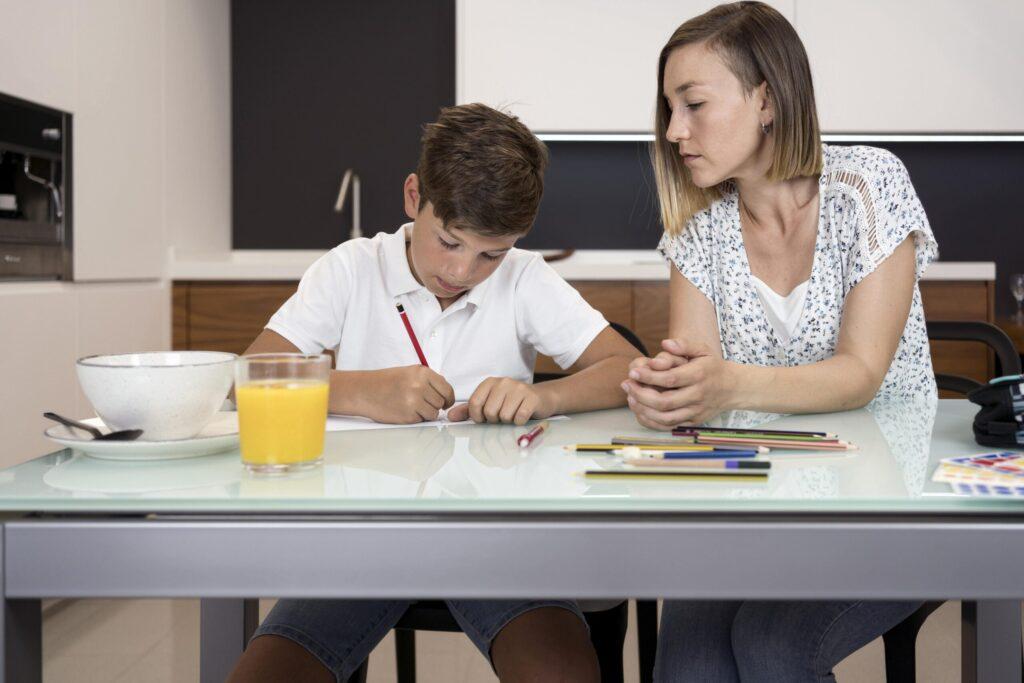
Sit beside them if you can, and avoid standing over them or forcing eye contact. Side-by-side usually feels less intense than face-to-face.⁸
If your child asks for space, give space while staying close enough for safety. Sharing what works at home with your child’s teacher is often the most useful thing you can do when these moments happen at school.
3. Lower the sensory load
A child who is overwhelmed does not need more input. Lower what you can.
Turn off the TV. Ask siblings to step away. Dim the lights if possible. Move to a quieter space if your child can do that safely.
You are not solving anything yet. You are just making the room easier to be in.
4. Use fewer words
Long explanations can feel like more pressure when a child is flooded. Keep your voice low and your words short.
This is not the time to ask what happened or why they did it. Those questions can wait.
Right now, your words just need to say: “I’m here.”
5. Offer comfort without forcing it
Some children calm down with a hug, a hand on their back, a weighted blanket, or sitting close. Others cannot handle touch when they are overwhelmed.
Offer comfort, then follow their lead. If they pull away, stay warm and nearby without forcing contact.
A cold cloth on the face can also help some children because it activates a reflex that slows heart rate quickly.⁶ Slow rocking, walking, wall pushes, or blowing bubbles can all help the body settle before any talking happens.
For more ways to support regulation and follow-through during daily routines, read Executive Functioning Skills for Kids.
6. Wait before teaching
This is the part that feels hardest because you probably want to correct the behavior right away. Hold that for later.
In the moment, your job is to keep things safe, lower the pressure, and stay connected. The lesson comes after your child is settled enough to take it in.
Waiting is not the same as ignoring the behavior. It is choosing the moment when your child can actually hear you.
What to Say and What Not to Say
Most parents have said these things in the middle of a hard moment. It is natural to reach for them, but they often backfire because they ask your child to use skills they cannot access yet.⁹
| What to avoid | Why it backfires | Try instead |
| “Calm down” | Asks for the thing they can’t access yet | “I’m right here” |
| “You’re fine” / “It’s not a big deal” | Can make them feel like they have to prove how upset they are | “I can see this is really hard” |
| “Use your words” | Language often gets harder during dysregulation | “You don’t have to explain yet” |
| “Look at me” | Can feel like pressure when they’re already overwhelmed | “I’m going to sit beside you” |
| “Stop crying or there will be consequences” | Adds threat to a moment that already feels too big | “We’ll talk about it later. I’m here” |
None of these are perfect. They just keep the door open until your child is ready.
After the Storm
When your child stops crying, yelling, or resisting, the moment can look over before it is actually over.
Stress hormones can stay elevated in the body after the visible meltdown ends, sometimes longer than parents expect.⁷ Start talking too soon and it either will not stick, or it restarts the whole thing.
Reconnect first. That might mean a hug, a snack, sitting together quietly, reading, or simply saying, “That was hard. I’m glad we’re okay.”
As a rough guide, wait at least 20 to 30 minutes after your child seems calm before trying to talk through what happened. Some children need longer.
When you do talk, keep it short. Ask what felt hard, what helped, and what you can try next time before things get that big.
If you yelled, repair it. “I’m sorry I yelled. I should have used a calmer voice.” That is the whole lesson.
Why Some Children Dysregulate More Often
Some children have bigger reactions because their regulation tank drains faster. A missed meal, a hard school day, anxiety, ADHD, sensory differences, or simply holding it together all day can drain that tank before dinner starts.
The meltdown at dinner is not always about dinner. Sometimes dinner is just the final push after the tank has already been drained.
If this is preventing your child from functioning, learning, or connecting across more than one setting, bring that to your pediatrician.
Building Regulation Skills Over Time
The middle of a meltdown is not the best time to teach regulation skills. That work happens during calm moments.
You can help your child notice what their body feels like before a big reaction, what makes things worse, and what helps them recover. Emotional Regulation in Children goes deeper on how this develops over time. Emotional Regulation Activities for Kids covers what to practice when things are calm.
When Big Reactions Show Up Around Learning
Big reactions show up most often around homework, reading, math, writing, or tasks that feel hard to start. If your child’s dysregulation seems to increase around school, it may help to look more closely at how your child learns, not just how they behave in the moment.
Kidaro’s Learning Profile helps parents better understand things like working memory, attention, emotional comfort with challenge, and how a child responds when something gets difficult. It is not a diagnosis or a label. It gives parents a clearer way to notice what may be underneath the frustration, so support at home can become less about guessing and more about what actually helps.

Stop guessing what’s actually getting in the way.
Sources
[1] Delahooke, M. (2022). Brain-Body Parenting: How to Stop Managing Behavior and Start Raising Joyful, Resilient Kids. HarperCollins.
[2] National Institute of Mental Health. “The Teen Brain: 7 Things to Know.”
[6] StatPearls. “Physiology, Diving Reflex.” National Library of Medicine.
[7] Center on the Developing Child, Harvard University. “Toxic Stress.”
[9] Child Mind Institute. “How to Help Children Calm Down.”
More for Parents:
- Why Is My Child Struggling in School?
- How to Help Your Child With Homework
- How to Motivate Kids to Study
- Procrastination Solutions for Kids
- When Kids Don’t Want to Go to School
- Supporting Your Child’s Spelling
- How to Help a Child Who Hates Homework
- How to Teach Executive Functioning
- Adaptive Learning in Education
- How Children Actually Learn
- Smart but Behind in School

Written by
Kidaro Team