

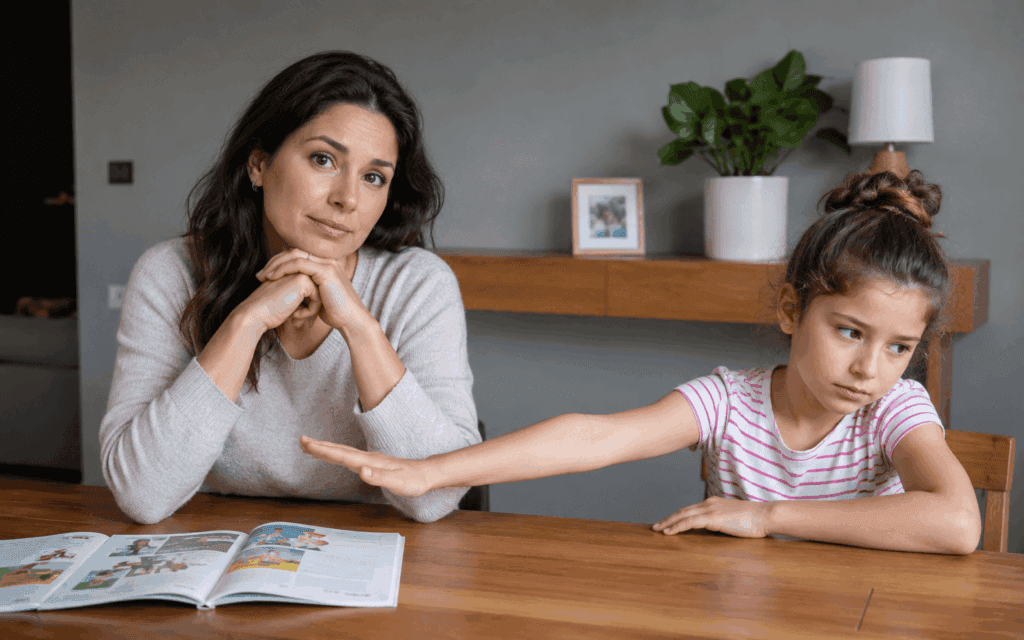
Your child just pushed the book away and said no. Not “I don’t feel like it.” Just a hard no. Maybe it ended in tears. Maybe it ended in a standoff. Either way, reading is now the thing you’re fighting about, and neither of you wanted that.
Here’s what matters in that moment: the refusal is not always about the book itself. It may be about pressure that has built up, a memory of being corrected, a sense that reading is something being done to them, or a quiet signal that reading is harder than it looks from the outside. Start here with these 5 tips, even if the resistance does not soften right away.
5 Things to Try When Your Child Refuses to Read
1. Don’t Make It a Battle
When reading has been turned into an instruction, refusal can become a predictable way to push back. Children who feel controlled do not typically think their way out of it. They push back harder.¹ ² The more you insist, the more the moment becomes about regaining a sense of control instead of the reading itself.
Drop the instruction entirely. That does not mean reading disappears from your household. It means you stop pushing while both of you are already frustrated and come back later with something smaller and calmer.
2. Let Them Pick Something That Doesn’t Look Like a “Real” Book
Comics, graphic novels, game manuals, sports magazines, captions in a documentary. It all counts.
Reading can become easier to resist when it feels like another school task or a performance.³ When a child chooses their own material in a format that does not feel loaded, the resistance may soften because there is less pressure attached to the choice.
This is not a trick to get them reading without realizing it. It is a way to let reading stop being the thing they associate with pressure.
A child who reads a Pokémon guide for twenty minutes has read for twenty minutes. That matters.
3. Read Near Them Without Asking Them to Join
Sit down with your own book. Do not invite them. Do not comment on what you’re reading. Do not make it a lesson. Just read.⁴
This removes the direct demand, which gives them less to refuse in that moment. Some children may eventually pick something up on their own. Others may not, at least not right away, and that is fine.
The goal is to make reading something the family does, not something the child is made to do. It changes what reading looks like in the household before asking the child to change.
4. Start With Listening, Not Reading
If reading has become a source of anxiety or shame, the page itself can be the trigger. An audiobook, you reading aloud, or a podcast about something they actually care about can keep them connected to stories and ideas without forcing the part that makes them shut down.⁵
For some children, following along in the physical book while an audiobook plays is a low-pressure way back to print. They are not performing. No one is watching for mistakes. The voice carries the reading; they just follow the words.
That small separation between reading and being evaluated may be enough to lower their guard.
5. Keep the First Ask Tiny
One page. One caption. One speech bubble. Not a chapter, not a long session, and not “at least try a little.” The goal is an experience of reading that ends before it turns bad.
This matters because removing every expectation may also reinforce avoidance, especially if the child never gets a chance to experience reading in a smaller, more manageable way.⁶
The middle ground is a calm, small expectation they can actually meet. End while the experience still feels manageable. That is the version of reading they will be more willing to repeat.
Why Pushing Harder Usually Backfires
The more a parent pushes, the more a child may resist. Feeling controlled can trigger more resistance, and refusal is often the most direct way for a child to regain a sense of freedom.¹ ²
For children who have been corrected frequently while reading, or who sense they are behind their peers, something else can layer on top of this. They may begin to see themselves as “not a reader.”
Once that belief takes hold, each reading invitation can feel less like a request and more like proof of something they would rather not confirm.⁵ In that moment, the refusal may be less about behavior and more about self-protection.
| A push response | A calmer alternative |
| “You need to read for twenty minutes.” | “Want to pick something short tonight?” |
| “Go pick a book.” | “Do you want the soccer book or the mystery?” |
| “You need to pick a chapter book, not a comic.” | “What do you actually feel like reading?” |
When the Refusal Might Be Telling You Something Else
Sometimes refusal is protecting a child from something that genuinely feels too hard. If the books available are too difficult, reading can take far more effort than the parent can see. Sometimes the refusal is the clearest way a child can show that the task feels harder than they know how to explain.
If backing off the pressure does not ease the refusal over time, pay attention to whether the child seems distressed rather than simply resistant. It is also worth noticing whether they understand far more when someone reads to them than when they read on their own.
Those patterns are worth bringing to a teacher or reading specialist. Not as an emergency, just as a conversation.
If you are past the refusal and ready to support their reading more directly, our guide, How to Help My Child With Reading, covers what to try next.
Understanding What’s Behind the Refusal
Reading refusal can look like stubbornness, but it may connect to how a child handles pressure, instructions, attention, or difficult tasks. When those patterns are hard to separate, parents can end up trying one strategy after another without knowing why some approaches help and others make the resistance worse.
Kidaro’s non-clinical Learning Profile helps parents recognize patterns in how their child approaches learning and challenges. It provides practical insights without diagnosing or labeling the child, so you can support them from a clearer picture instead of relying on guesswork.

Stop guessing what’s actually getting in the way.
Sources
- Quick, B. L., et al. “A 50-Year Review of Psychological Reactance Theory.” Scholar Works, Dominican University, 2021.
- Kuczynski, L., Pitman, R., and Twigger, A. “Flirting With Resistance: Children’s Expressions of Autonomy During Middle Childhood.” International Journal of Qualitative Studies on Health and Well-Being, 2019.
- “Parent–Child Shared Book Reading Challenges and Facilitators: A Meta-Synthesis.” Frontiers in Psychology, 2025.
- Purdue University College of Education. “Motivating K–12 Students to Read Independently.” 2026. Drawing on Stephen Krashen’s research on free voluntary reading and reading models.
- McArthur, G. “Poor Reading and Anxiety (PRAX): Building a Theory and Practice.” Australian Catholic University and Macquarie University, 2021–2022.
- Child Mind Institute. “What to Do (and Not Do) When Children Are Anxious.” 2025.
More for Parents:
- How to Improve Working Memory in Children
- Executive Functioning Skills for Kids: A Parent’s Guide
- Emotional Regulation in Children: What It Is and How to Help
- How Children Learn Best
- How to Motivate Kids to Study
- Preventing Procrastination in Children
- Reasons Kids Hate School
- Spelling Improvement for Kids
- How to Support Homework at Home
- Kids and Executive Functioning
- Adaptive Learning Solutions for Kids
- How Kids Learn Differently
- My Kid Is Smart but Struggling
- When Should a Kid Be Able to Read?

Written by
Kidaro Team