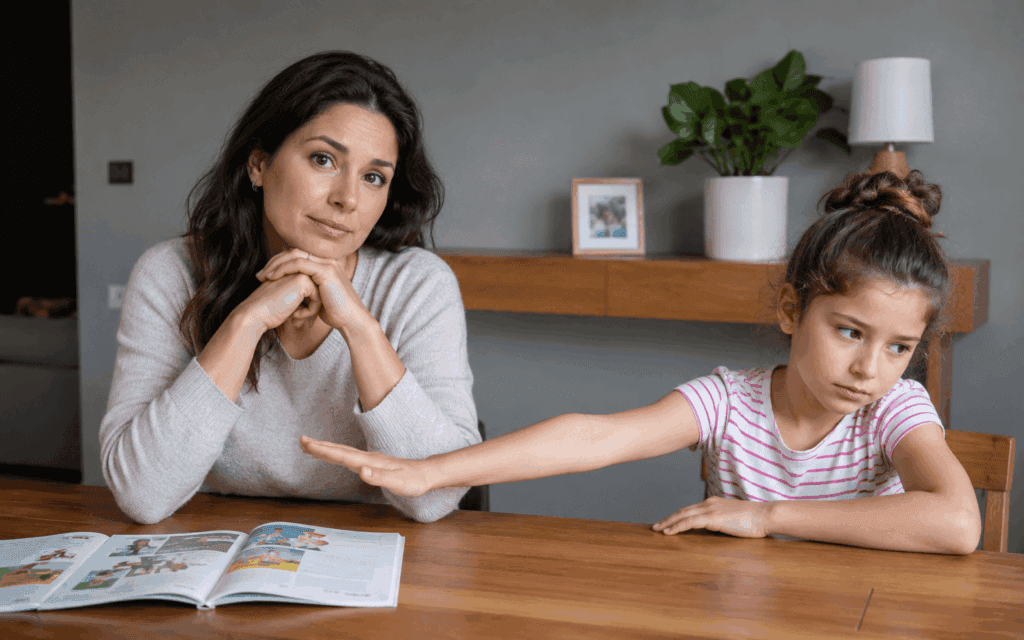


You’ve been through the routine. You remind your child again and again, “hey, it’s time to study, please get started”. You sit across the table watching them stare at the ceiling, pick at a pencil, do anything but start. And somewhere in the back of your head, a word keeps forming to describe such behavior: “lazy”. But, contrary to popular belief, “laziness” usually isn’t the real problem. Most of the time, it points to something underneath: trouble starting, fear of getting it wrong, or a task that feels too big before your child even begins.
If the problem is more about the study session itself, like routine, setup, or how to help without taking over, How to Motivate Kids to Study Without a Fight covers that.
That being said, here are five things you can do tonight when the pattern looks like “laziness”.
Acknowledge What They’re Feeling First
If your child is already tense, going straight to “time to study” usually makes it worse. A quick acknowledgment of what you see can take enough edge off to get things moving. Try: “You look like you really don’t want to do this right now. That’s pretty normal.” Then ask, “What part feels the worst?” You don’t have to turn this into a long emotional conversation. Just name what you see, give them a second, and move toward the first step.
Ask for One Small Start, Not the Whole Assignment
Don’t ask them to do the whole assignment. Ask them to write their name on the page. That’s it. The resistance is often to starting, not to the work itself. Once they’ve done one small thing, many kids are more willing to keep going. No big speech. No “see, that wasn’t so hard.” Just let the momentum do some of the work.
Build an If-Then Plan Together
An if-then plan connects a specific daily moment to a specific action. Instead of “do your homework after your snack,” make it concrete: “After you put your backpack down and have your snack, you open your reading folder to the bookmarked page.” The more specific the plan, the less deciding they have to do. That matters because the decision is often where everything starts falling apart. A 2026 review of 42 studies found that this reliably improves follow-through in children, especially in kids whose self-regulation is most limited.³
Sit Nearby Doing Your Own Work
Bring your own work to wherever your child is studying. Don’t supervise, don’t check on them, don’t hover. Just be there. Kids who resist homework or studying often feel alone with something they already want to avoid. Your quiet presence gives them a steady anchor without adding more pressure. This is not about doing the work for them. It’s about making the start feel less like they’re being sent into it by themselves.
Change One Small Thing About the Setup
Offer a small choice that shifts something about the moment: kitchen table or the floor, regular pencil or colored pen. Kids who resist homework often have a stress response tied to the usual setup. Same table, same time, same fight. At some point, the setup itself starts doing some of the triggering. Changing one detail can interrupt that pattern before the resistance fires. Nothing dramatic. Just enough to make the moment feel a little different.
Why Calling Them “Lazy” Makes It Worse
When a child internalizes “I’m lazy,” they stop thinking “I didn’t try hard enough” and start thinking “that’s just who I am.” If being lazy is a trait, trying harder feels pointless. The beliefs children form about their ability during the elementary years shape achievement well into adolescence.¹
| Instead of | Try | Why it works |
| “You’re lazy.” | “You’re avoiding this. What’s making it hard?” | Describes a behavior, not a permanent trait |
| “You’re so smart, you should be able to do this.” | “This is hard. What part is getting in the way?” | Removes the pressure of a label the child feels they have to protect |
| “You just don’t care.” | “It looks like you’ve checked out. What happened?” | Opens a conversation instead of closing it |
Trait-based framing, positive or negative, produces less persistence after difficulty than focusing on the process.²
If task-starting is a recurring issue beyond studying, our guide to Executive Functioning Skills for Kids can help you understand what may be getting in the way.
When It’s Not Laziness at All
Sometimes avoidance isn’t about motivation at all. If the resistance shows up across most school tasks, most days, for months, that’s a different pattern. Same if physical symptoms like stomachaches or headaches appear before school and disappear on weekends. That pattern is worth taking seriously.
A child who shuts down only around one subject may be working around a learning gap they can’t name yet. When nothing you’ve tried has worked, avoidance may be the only coping strategy they have.
If any of that sounds familiar, start with your pediatrician or teacher. And whether or not you go that route, Kidaro can help you understand your child’s learning profile so you can respond with clarity instead of guessing.

Stop guessing what’s actually getting in the way.
Sources
- Susperreguy, M. I., Davis-Kean, P. E., Duckworth, A. L., & Chen, M. (2018). Self-concept predicts academic achievement across levels of the achievement distribution. Child Development, 89(6), 2205–2220.
- Fong, C. J., Muenks, K., Fathi, Z., Adelugba, S. F., O’Grady, M. C., Lin, S., & Goldstein, M. G. (2025). Do socializers’ mindset beliefs matter for student mindset and achievement? A meta-analysis. Learning and Individual Differences, 121.
- Breitwieser, J., & Reinelt, T. (2026). The effectiveness of implementation intentions in children: A systematic review and meta-analysis. British Journal of Psychology. Advance online publication.
More for Parents:
- How to Reduce Procrastination in Kids
- Why Is My Child Struggling in School?
- End Procrastination in Children
- Children Hating School
- Spelling Exercises for Kids
- Homework Made Easier for Kids
- Executive Function and Kids
- Adaptive Learning Benefits for Kids
- Science of How Children Learn
- Capable but Not Performing

Written by
Kidaro Team