
Picture this, your child just got eight right in a row on their math facts. Then the worksheet flips to word problems, and the pencil goes still.
They stare. They erase. They say, “I don’t get it.” Or they grab two numbers from the problem and guess. This is especially common in elementary school, around grades 2–5, when word problems start moving from simple one-step stories into comparison, multi-step, time, money, and early multiplication problems.
Your child may know how to subtract, but still freeze when subtraction is hidden inside a story. Now they have to read, remember the details, figure out what matters, choose the math move, and keep track of the steps. That is a lot for one problem.
Why Math Word Problems Feel Harder Than Regular Math
With a regular calculation, like 14 − 6 = ?, the problem gives the child the operation. The numbers are there. The subtraction sign is there. The task is clear.
A word problem is different. The child has to figure out the situation before they can solve it. The calculation may not be the hard part, but rather breaking down the story correctly in order to reach the answer.
Researchers often describe this as working memory load: too much to hold in the mind at once. For a child, that can feel like freezing, guessing, rushing, or saying, “I don’t know what to do.”¹
For a broader look at how math struggles can come from different places, read: Why Is My Child Struggling With Math?
What You See at Home vs. What May Be Happening
The instinct is often to say, “Just read it again.” But if your child does not understand the story, or cannot tell what the question is asking, reading the same confusing sentence twice may only increase frustration.
That is why it helps to look at what is actually happening when they get stuck. The behavior you see during homework can be useful. Not because it tells you something is “wrong” with your child, but because it can show where the problem is breaking down.
| What you see at home | What may actually be happening |
| They grab two numbers and add them | They may be guessing instead of understanding the story |
| They can calculate but miss the question | Reading or language may be getting in the way |
| They get lost halfway through | The problem may be overloading working memory |
| They say “I don’t know what to do” | They may not know how to start or organize the steps |
| They get it one day but not when the wording changes | They may be relying on surface clues instead of the structure of the problem |
The point is not to label the child. The point is to notice the pattern.
A child who gets a problem right on Monday but misses a similar one on Thursday may not be careless. They may have learned to recognize a familiar setup without fully understanding the structure underneath it. When the wording changes, the clue they were relying on disappears.
Why Kids Grab Numbers and Guess
One common word-problem pattern is simple: the child scans the page, finds two numbers, and does something with them. They add. They subtract. They guess.
This usually happens when the child is overwhelmed and wants to do something familiar. Numbers feel safer than the story. But word problems are not solved by numbers alone. They are solved by understanding the relationship between the numbers.
The wording itself can also make a problem harder, especially when phrases like “how many more,” “fewer than,” or “the difference between” are unfamiliar.² Those phrases can sound like clues, but they still have to be understood inside the full story.
For example:
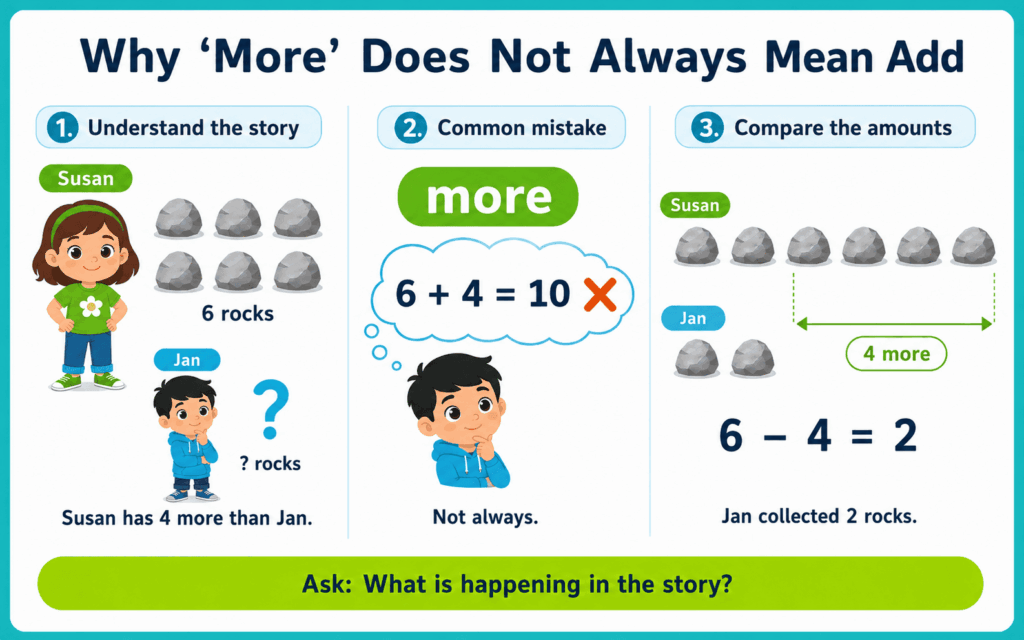
Susan collected 6 rocks, which was 4 more than Jan collected. How many rocks did Jan collect?
A child who sees “more” and automatically adds 6 + 4 will get 10. But the story says Susan has 4 more than Jan, so Jan has fewer. The answer is 2.
That is why keyword tricks in word problems can break down. Words like “more,” “altogether,” or “fewer” can sometimes give a clue, but they do not reliably tell a child which operation to use. In multi-step word problems, keyword strategies become even less reliable.³
A better question is:
What is actually happening in the story?
That question helps children move from guessing to reasoning.
Why Multi-Step Word Problems Are Especially Hard
A one-step word problem asks a child to understand the story and do one piece of math.
A two-step word problem asks them to solve one part, remember that answer, and use it in the next part. That is a lot more for a child to manage.
Here is a simple example:
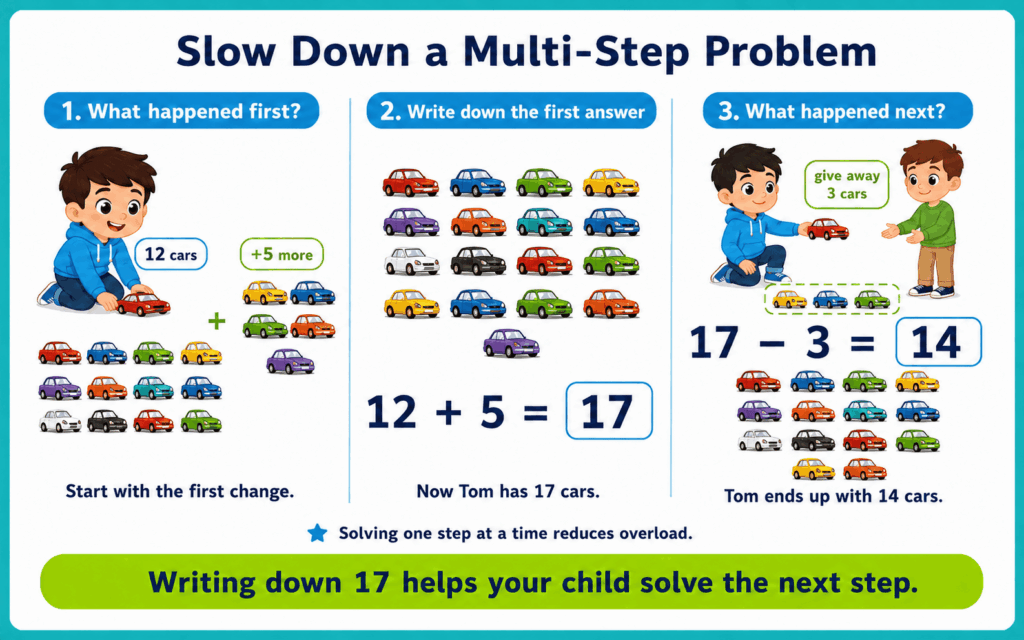
Tom had 12 toy cars. He bought 5 more. Then he gave 3 away. How many does he have now?
Instead of asking your child to solve the whole thing at once, slow it down:
“What happened first?”
He had 12 and bought 5 more.
“Let’s solve just that part. What does he have now?”
17.
“Now use that answer. What happened next?”
He gave 3 away.
“So what does he end up with?”
14.
“Does that make sense with the story?”
Writing down the first answer matters. Once 17 is on the page, your child does not have to hold it in their head while solving the next step. That frees up mental space for thinking.
For more on this, read: How to Improve Working Memory in Children
What Parents Can Do Before Their Child Starts Calculating
Most word-problem mistakes happen before the math starts. The setup matters.
Before your child reaches for an operation, ask them to tell you the story in normal language. You might say, “Forget the numbers for a second. What is happening here?” If they cannot explain the situation, they are not ready to calculate yet.
Then help them find the actual question. Many children read the whole problem but miss what it is asking. Have them circle or underline the question sentence. That small move can stop them from solving the wrong thing.
If your child grabs numbers too quickly, cover the numbers for a moment. Ask whether the answer should get bigger, smaller, or stay connected to a comparison. This helps them think about the situation before jumping into a calculation.
When you’re sitting next to them, these questions can help guide the conversation:
- “Tell me the story without the numbers first.”
- “What changed in the problem?”
- “What is the question asking?”
- “Should the answer be bigger or smaller than what we started with?”
The goal is not to make the process longer forever. The goal is to slow it down long enough for your child to understand what they are solving.
For broader math support at home, read: How to Help My Child With Math
Why Drawing the Problem Helps
A quick drawing can do something powerful: it gets the problem out of your child’s head and onto paper.
The drawing does not need to be neat. It can be a sketch, a number line, two bars, a few boxes, or simple groups. The point is to make the relationship visible.
Take this problem:
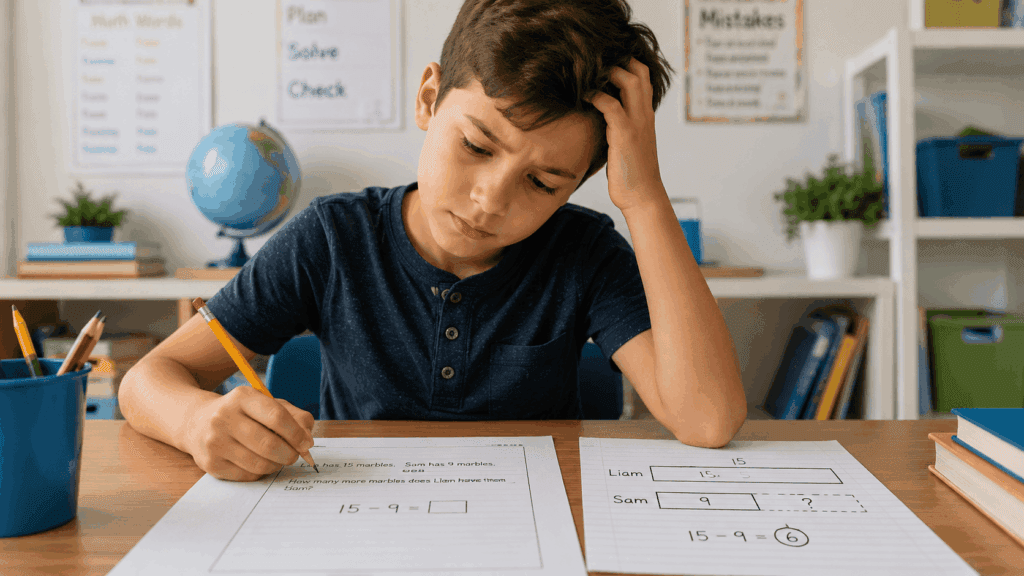
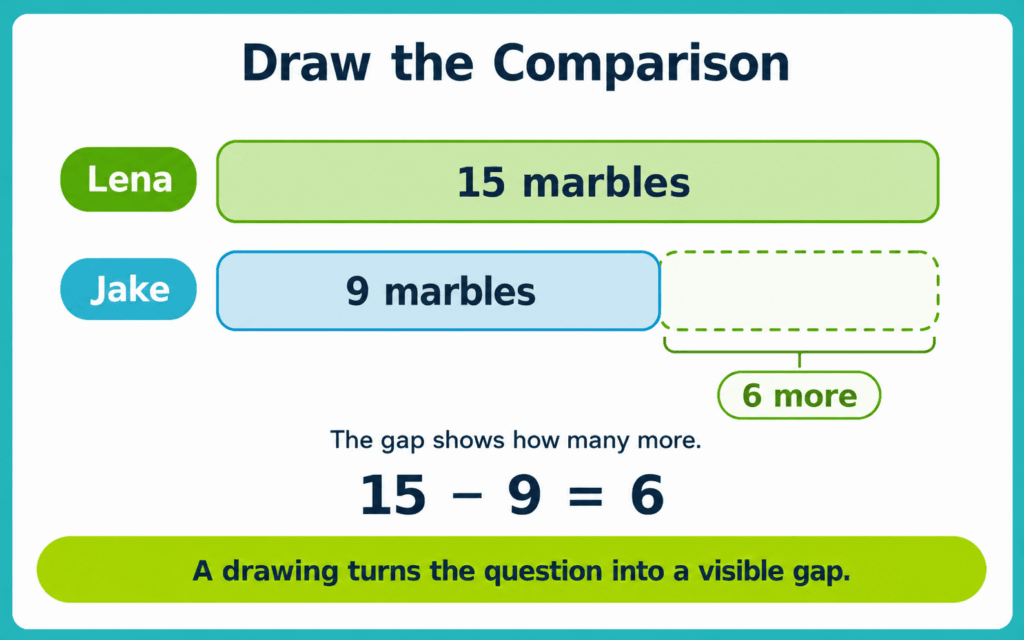
Lena has 15 marbles. Jake has 9 marbles. How many more marbles does Lena have than Jake?
Some children see 15 and 9 and rush to calculate without understanding the comparison. Drawing two bars, one longer for Lena and one shorter for Jake, makes the missing part easier to see. The “how many more” question becomes a gap, not just a phrase.
Visuals are especially helpful for comparison problems, equal groups, and multi-step problems because they reduce how much a child has to hold in their mind at once.⁴
How to Help Without Doing the Work for Them
The hard part is knowing how to help without taking over.
When a child is stuck, it is tempting to explain the whole problem or give the first step. Sometimes that feels faster. But if the child only watches you solve it, they may still not know what to do next time.
Try helping with the thinking process instead of the answer. Ask:
- “How did you decide that?”
- “Does your answer make sense?”
- “What could you try first?”
The parent’s job is not to solve it faster. It is to help the child slow down enough to think.
If your child says, “I don’t know where to start,” back up. Say, “Let’s leave the math alone for a second. Just tell me what is happening in the story.”
That gives them a way in.
When Word Problems Keep Turning Into Homework Stress
Frustration is normal. But if word problems regularly lead to shutdown, tears, or strong resistance, pushing harder usually does not help.
Pressure makes thinking harder. When a child is anxious, rushed, or embarrassed, they have less mental space available for reading carefully, choosing a strategy, and checking their work. Math anxiety is also linked with lower math performance, especially when stress interferes with working memory.⁵
A few small changes can help. Keep practice short, and stop before frustration takes over. Try not to make speed the goal, and be careful with comments like “I was bad at math too” – they can make the struggle sound permanent. A better phrase might be, “Let’s figure out where it got confusing.” That kind of language tells your child you’re solving it together, not judging them.
What Your Child’s Word Problem Struggles May Be Telling You
Not every child struggles with word problems for the same reason. Those differences matter.
A child who grabs numbers and guesses may need help slowing down and retelling the story. A child who gets lost halfway through may need each step written down. A child who struggles when wording changes may need help seeing the structure of the problem instead of relying on surface clues.
Once you know where the problem breaks down, the support becomes more specific. It also gives you better language for talking with your child, helping during homework, or asking a teacher what they are seeing at school.
For related support around planning, starting tasks, and organizing steps, read: Executive Functioning Skills for Kids
Understand Your Child’s Learning Profile With Kidaro
That same idea is at the center of Kidaro’s Learning Profile: understanding how your child approaches learning so support can fit the actual sticking point.
Kidaro helps parents better understand learning patterns in a practical, non-clinical way. It is not a diagnostic tool, and it is not about labeling a child. It helps parents notice where learning gets stuck so the help can be more specific. If your child freezes on math word problems, rushes through without reading, forgets steps, or does better when the problem is drawn out, a clearer Learning Profile can help you understand what kind of support may actually fit.

Stop guessing what’s actually getting in the way.
FAQs
Sources
- Orosco, Michael J. “Study Shows Addressing Working Memory Can Help Students with Math Difficulty Improve Word Problem-Solving Skills.” ScienceDaily, 21 Apr. 2025.
- Vessonen, Terhi, et al. “Task Characteristics Associated with Mathematical Word Problem-Solving Performance Among Elementary School-Aged Children: A Systematic Review and Meta-Analysis.” Educational Psychology Review, vol. 36, no. 4, art. 117, Oct. 2024.
- Taber, Mary T. “What Is a Keyword Strategy and What Are Its Limitations?” NC2ML Research Brief, North Carolina Collaborative for Mathematics Learning, 2020.
- Regional Educational Laboratory Northeast & Islands. “Supporting Mathematical Problem Solving at Home.” Institute of Education Sciences, U.S. Department of Education, 2025.
- BrainsCAN. “Causes and Consequences of Math Anxiety in Children.” BrainsCAN Educate, Western University, 2018.
More for Parents:
- How to Motivate Your Kids in School
- How to Get Kids to Stop Procrastinating
- Why Some Kids Don’t Like School
- Spelling Activities for Kids
- Helping Your Child With Schoolwork
- Executive Functioning in Children
- How Personalized Learning Works
- Best Learning Strategies for Kids
- Why Is My Smart Child Failing

Written by
Kidaro Team