
Your child slides a worksheet across the table. “Mom, can you help? I tried everything, but I don’t get it.”
You say yes, lean in, and realize this does not look like the division you remember. There is a rectangle broken into sections, numbers written inside it, and a divisor sitting on the side. Somehow, this is supposed to be division.
That is usually the moment parents start Googling. If you searched “what is area model division,” you are in the right place.
Area model division is a visual way to break one big division problem into smaller, more manageable parts. Instead of jumping straight into traditional long division, children use a rectangle to show how a number can be split into groups. This guide explains how it works, how it connects to long division, what to do with remainders, and how to help when your child gets stuck.
For a broader look at the rectangle model itself, read What Is the Area Model in Math?
What Is Area Model Division?
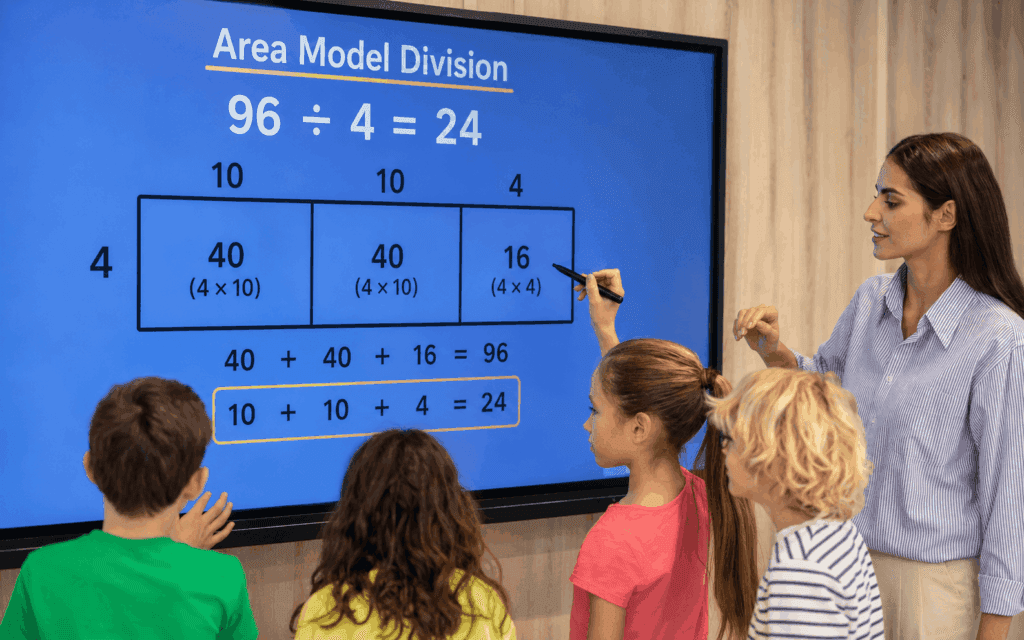
Area model division uses a rectangle to break a division problem into smaller parts. Each part is easier to divide. Your child solves the pieces, then adds them together.
Here is the basic idea:
- Dividend: the number being divided. This is the total amount inside the rectangle.
- Divisor: the number you are dividing by. This usually goes on the left side.
- Quotient: the answer. This is built from the numbers across the top.
- Partial quotients: the smaller answers that get added together to make the final quotient.
Area model division is the reverse of area model multiplication. In multiplication, your child knows both sides and finds the area. In division, they know the area and one side, then find the missing side.¹
Same rectangle. Different question.
The goal is not for your child to draw a perfect box. The goal is for them to break the division problem into parts they can actually manage.
A Simple Example: 96 ÷ 4
Start with the rectangle.
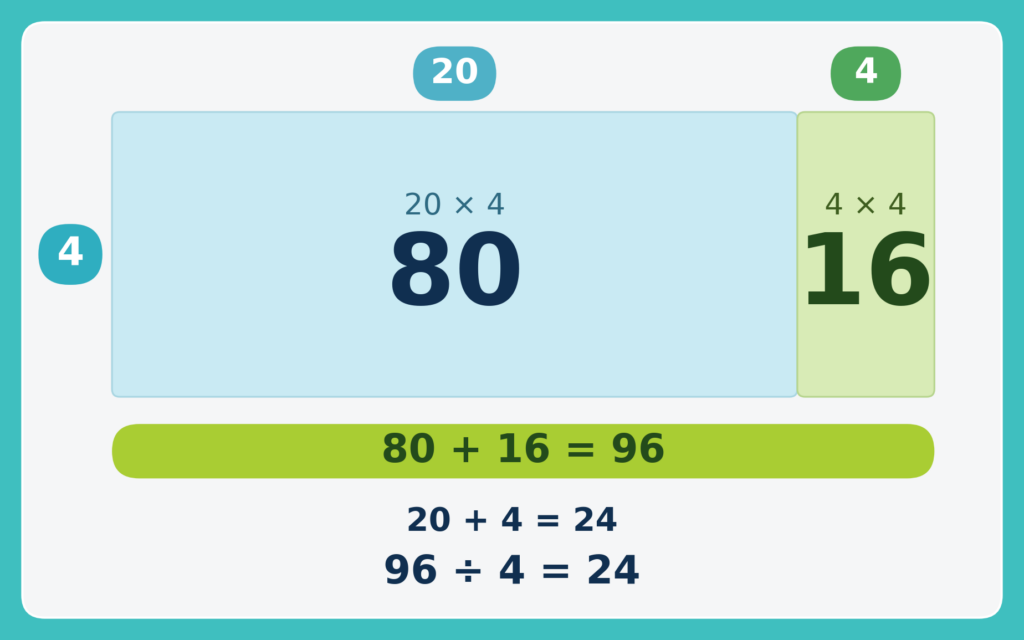
Write 96 inside because that is the number being divided. Write 4 on the left because that is the divisor.
Now break 96 into parts that are easy to divide by 4:
80 + 16
Then solve each part:
- 80 ÷ 4 = 20
- 16 ÷ 4 = 4
The numbers on top are the partial quotients. Add them:
20 + 4 = 24
So:
96 ÷ 4 = 24
That is the basic method.
Pick friendly chunks. Divide each chunk. Add the pieces on top.
A Larger Example: 378 ÷ 6
The same idea works with larger numbers.
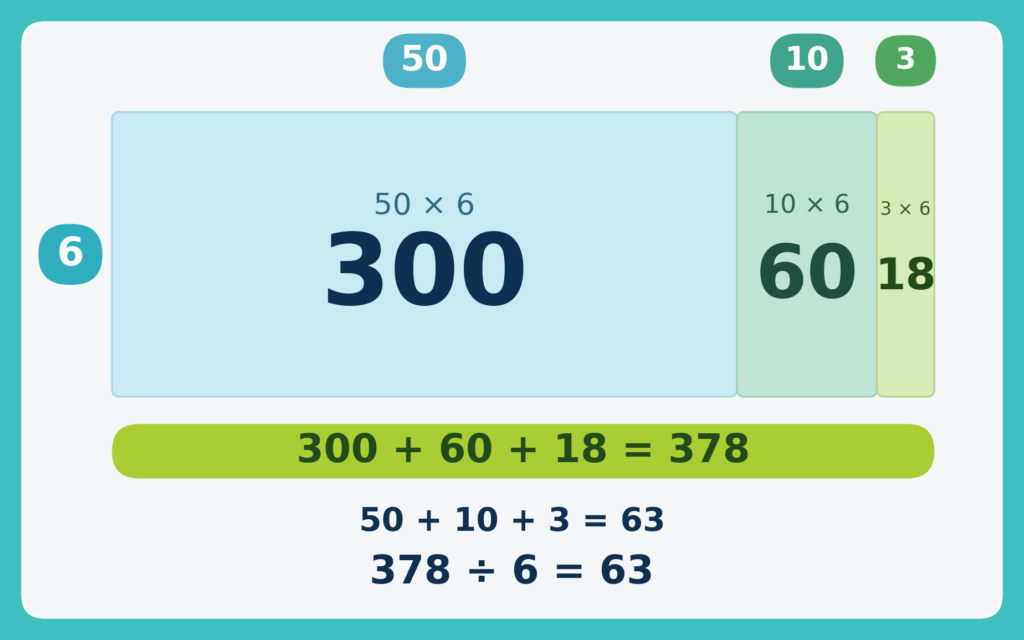
For 378 ÷ 6, your child can break 378 into chunks that divide cleanly by 6:
300 + 60 + 18
Then:
- 300 ÷ 6 = 50
- 60 ÷ 6 = 10
- 18 ÷ 6 = 3
Now add the partial quotients:
50 + 10 + 3 = 63
So:
378 ÷ 6 = 63
Your child does not always have to break the number apart the exact same way as the textbook.
Another child might use:
360 + 18
That gives:
60 + 3 = 63
Same answer. Fewer steps.
If your child uses smaller chunks than the example but gets the right answer, do not rush to correct them. They may just be taking a slower path.
What About Remainders?
Sometimes the number does not divide evenly.
Take 475 ÷ 8.
A child might start with:
8 × 50 = 400
That leaves:
75
Then:
8 × 9 = 72
That leaves:
3
Now stop. Since 3 is smaller than 8, it cannot make another full group of 8.
The quotient is:
50 + 9 = 59
The remainder is:
3
So:
475 ÷ 8 = 59 R 3
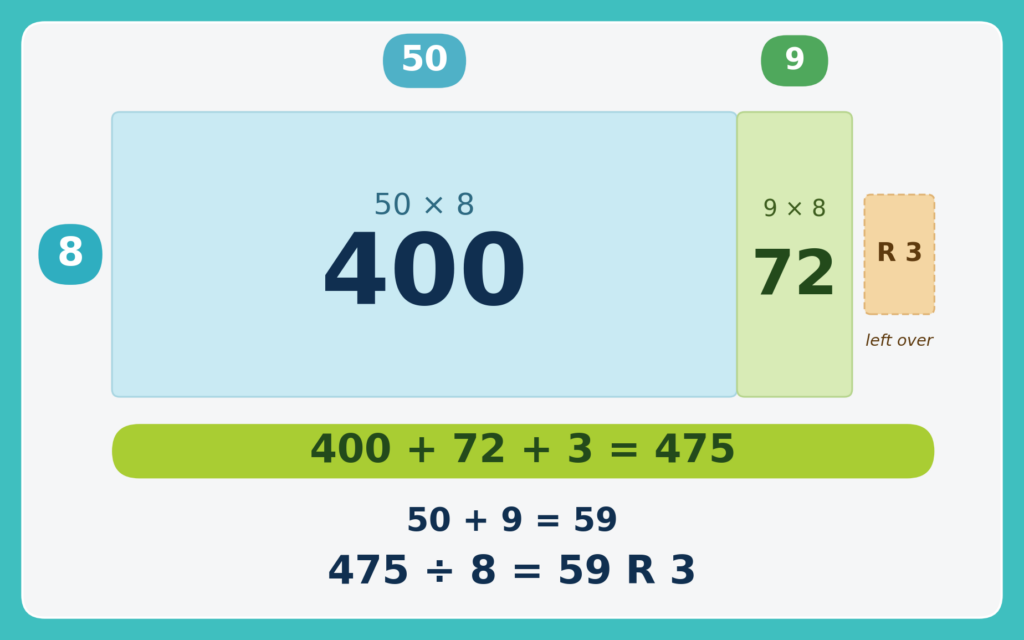
A remainder is not a mistake. It is just the amount left over when there is not enough to make another full group. Common Core’s Grade 4 standard includes whole-number quotients and remainders using strategies such as rectangular arrays and area models.²
That is all it means.
How Area Model Division Connects to Long Division
Area model division can feel strange if you learned long division first. But it is not a totally different kind of division.
It is the same math shown in a more visible way.
Long division compresses the steps. Area model division spreads them out so the child can see what each step means.
For example, when a child writes 50 above a section with 300 inside, they are showing:
6 × 50 = 300
In long division, that same thinking is hidden inside the standard algorithm.
That is why schools often teach area model division first. It helps children understand the division before the steps become shorter and more procedural. Research-backed math guidance supports using concrete and semi-concrete representations to help children connect concepts and procedures.³
If the homework asks for area model division, try not to switch your child straight to long division. Even if long division feels faster to you, changing methods can make the assignment more confusing.
For more on this shift, read New Math vs Old Math.
Where Kids Get Stuck With Area Model Division
Most problems happen in a few predictable places.
1. They choose chunks that are too small
Your child may subtract 6 again and again instead of using a larger chunk like 60 or 300.
The math may still be right, but it takes forever.
Try:
“Can you find a bigger group?”
2. They do not know which multiples to use
Sometimes the child understands the model but cannot quickly find a helpful multiple.
Before solving, write a quick menu on the side:
- ×10
- ×20
- ×50
- ×100
If the divisor is 6, that gives them numbers like 60, 120, 300, and 600 to think from.
3. They pick chunks that do not divide cleanly
For 378 ÷ 6, a child might try:
300 + 70 + 8
But 70 does not divide evenly by 6.
Try:
“Can you find a number close to 70 that 6 goes into?”
That nudges them toward 72 or 60.
4. They forget to add the partial quotients
A child may solve each box correctly, then forget that the numbers on top need to be added.
Try:
“You found all the pieces. Now what is the total?”
5. They lose track of what is left
Area model division has several steps. A child may understand the method but lose track of what has already been subtracted.
That is not always a division issue. Sometimes it is a tracking issue.
Have them write what is left after each chunk. Do not make them hold it all in their head.
If this happens often across multi-step work, read How to Improve Working Memory in Children.
6. They mix up where the numbers go
Some children put the dividend on the side, the divisor inside, or the partial quotients in the wrong place.
That can make the whole model fall apart.
Walk through the labels again:
- total amount inside
- divisor on the side
- partial quotients on top
Sometimes the math is fine. The layout is what is confusing them.
How to Help Your Child With Area Model Division at Home
You do not need to reteach the whole lesson.
Start smaller.
Ask:
“Show me what you did first.”
That question usually tells you where the confusion started.
Then check the rectangle. Is the dividend inside? Is the divisor on the side? Are the partial quotients on top?
If the setup is wrong, the rest of the work will probably feel wrong too.
A few simple moves help:
- Make a quick list of friendly multiples before starting.
- Write down what is left after each subtraction.
- Remind your child to add the partial quotients at the end.
- Treat remainders as normal, not as mistakes.
- Keep the session short.
One or two problems together is enough.
And praise the process, not the speed. A child who takes three chunks to solve the problem carefully is still learning the method. Guidance from EEF also emphasizes that representations and manipulatives are tools for developing mathematical understanding, not shortcuts around it.⁴
For broader homework support, read How to Help My Child With Math.
Understand Your Child’s Learning Profile With Kidaro
If area model division keeps falling apart in the same places, the issue may not be division alone. Your child may understand the idea but lose track of the steps, get thrown off by the layout, or struggle when the numbers change.
When the same kind of breakdown shows up across math assignments, it can help to look beyond the worksheet. Kidaro helps parents understand how their child approaches learning through a Learning Profile. It is not a diagnosis and it is not a label. It is a practical way to see where schoolwork may be getting stuck, so you can support your child with more clarity.
Sign up today and get full clarity on how your child learns.

Stop guessing what’s actually getting in the way.
Sources
[1] Math Learning Center / Bridges — Models in Bridges
[2] Common Core State Standards — CCSS.Math.Content.4.NBT.B.6
[4]Education Endowment Foundation — Improving Mathematics in Key Stages 2 and 3
More for Parents:

Written by
Kidaro Team