

Your kid reads the word problem. Reads it again, and again. Then stares at it like it owes them money, and they end up either scribbling down a random number or skipping the problem entirely. That “freeze” isn’t always a math problem. A lot of the times, it’s a language problem.
In the past, we’ve written about why word problems trip kids up: the reading demands, the hidden vocabulary, and the way problems disguise their structure. This article is the what-to-do-about-it companion. Step by step, for tonight.
One thing first: how you help matters more than how much.¹ Jumping in with the answer, rushing them, or sighing through the problem can make math feel even bigger than it already does. The goal isn’t to solve it for them. It’s to guide them through a process they can eventually use on their own.
It works whether the problem is about sharing stickers, buying movie tickets, or comparing baseball cards. Simple enough to remember. Useful enough to use right now.
Read It Like a Story, Not a Math Problem
Before any pencil touches paper, read the whole problem out loud together. Slowly. No math yet, just words.
Then put the problem face-down, or cover it, and ask your child to tell you what just happened. Not what operation they need. Not what answer they think it is. Just the story.
Something like:
“Two kids were collecting rocks. One had more than the other. They wanted to know the difference.”
That’s enough.
This one move does more than almost anything else. Word problems depend heavily on language comprehension.² A child may know how to add, subtract, multiply, or divide, but still get stuck because they don’t understand what the problem is actually describing.
If your child can’t retell the problem without looking at it, they’re not ready to solve it yet. That’s not failure. It’s information. Go back and read it again, one sentence at a time.
For extra practice between homework sessions, take any word problem and cover the numbers with a sticky note. Read it together and ask: “What’s happening in this story?” For example: “Emma had some apples. She gave some to her friend. Now she has fewer.” No numbers visible, but your child can tell something was taken away. That’s subtraction. Teachers call these “numberless word problems,” and the California Mathematics Framework recommends them across elementary grades.³
Find the Question, Then Find the Facts
Now your child picks up the pencil.
Give them two jobs only:
- Underline the actual question: what is the problem asking them to find?
- Circle or note the numbers and facts that matter.
Most word problems at this age come down to one of three things happening:
| What’s happening? | What it usually means | Example |
| Things are being put together | Parts are combining into a whole | “Rosie planted 12 sunflowers and 8 marigolds. How many flowers total?” |
| Things are being compared | Two amounts are being compared | “How many more sunflowers than marigolds did Rosie plant?” |
| Something changes | A starting amount goes up or down | “Rosie had 20 seeds. She planted 4. How many does she have left?” |
That’s the question you want your child asking: “What’s happening in this story?”
Not: “What word tells me what to do?”
That second question is the trap.
Signal words like “altogether,” “more,” or “remaining” can be clues, but they’re not reliable decision rules. “More” doesn’t always mean add.
Consider this:
“Rosie picked 6 rocks. That was 4 more than Jake picked. How many rocks did Jake pick?”
The answer is 2, not 10.
If a child sees “more” and automatically adds, they miss the relationship in the story. In one study, accuracy dropped to around 35% when kids relied on keywords that didn’t match the correct operation.⁴ That’s why keyword shortcuts can fall apart, especially as word problems get more complex.
Teach your child to read the situation, not the signal word.
One more thing: not every number in a word problem is important. Some problems include extra facts on purpose. If your child identifies the question first, the irrelevant numbers become much easier to ignore.
Turn the Story Into Math, Then Solve It
Now comes the translation step: from story to equation. This is where a quick drawing earns its keep.
If your child understands the problem but freezes at “I don’t know what to write,” have them draw a bar model. It sounds fancier than it is. Draw one rectangle, split it into sections that represent the quantities in the problem, and mark the unknown with a question mark.
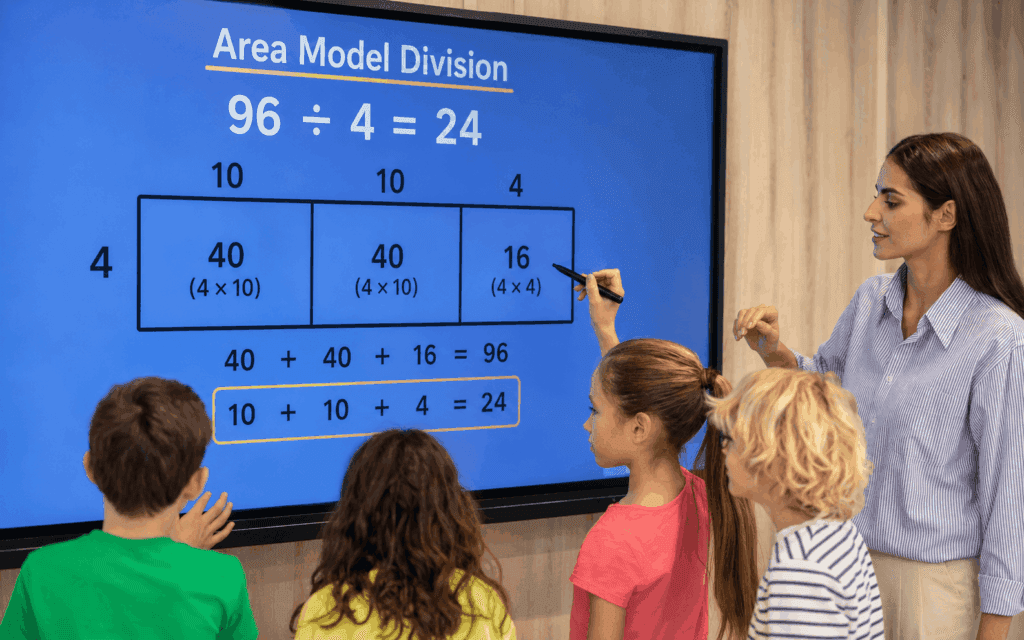
If drawings and visual models are showing up often in math homework, our guide to what the area model is in math can help you understand why schools use visual strategies.
No rulers. No graph paper. Scrap paper and a pen are enough.
The point isn’t to make a perfect drawing. The point is to get the information out of your child’s head and onto the page. A Vanderbilt IRIS Center review found that children who sketch out word problems are six times more likely to get the right answer.⁵ Another 2026 study found that even partially correct bar models led to correct answers more than 80% of the time.⁶
So if the drawing is messy, that’s fine. It just needs to make the story visible.
For example:
“Marcus had 48 baseball cards. He gave 15 to his brother. Then he bought 9 more at the store. How many does Marcus have now?”
Your child could sketch it like this:
Started with: 48 cards
Gave away: -15 cards
Bought more: +9 cards
Now has: ?
Or even simpler:
48 cards → take away 15 → add 9 → ?
That’s enough.
Once the story is visible, the equation is easier to write:
48 − 15 = 33
33 + 9 = 42
Then stop and ask one more question:
“Does that answer make sense?”
Go back to the story. Marcus gave away 15 cards and bought 9 more. Since he gave away more than he bought, the final number should be less than 48. So 42 makes sense.
Here’s the full process for a 9–10 year old:
- Read and retell: Marcus started with some cards, gave some away, then got more.
- Identify the question: How many does Marcus have now?
- What type of problem is this? Something changes twice.
- Draw it: Start with 48, take away 15, then add 9.
- Write the equation: 48 − 15 = 33. Then 33 + 9 = 42.
- Check: 42 is less than 48, which makes sense because he gave away more than he bought.
That’s the habit you want to build: read, retell, identify, draw, solve, check.
A Shortcut That Helps (and When It Doesn’t)
Some classrooms teach a strategy called CUBES:
- Circle the numbers.
- Underline the question.
- Box the key words.
- Evaluate.
- Solve and check.
If your child’s teacher uses it, it’s worth knowing. Reinforcing the same system at home and school can reduce confusion, and the basic structure is useful. It gets kids to slow down, mark up the problem, and organize their thinking before solving.
The honest take on CUBES: it works well as training wheels.
The weak spot is the “box the key words” step. We already covered why keywords don’t reliably match the right operation, so that’s the part to adjust.
The What Works Clearinghouse (WWC), an initiative of the U.S. Department of Education’s Institute of Education Sciences, points educators toward understanding the structure of a problem rather than relying on keyword shortcuts alone. That’s why CUBES is better treated as a starting scaffold, not the whole method.⁷
A simple fix: keep the structure, but swap the “B” step with the question we’ve been using throughout this article: “What’s happening in the story?”
That single swap keeps the helpful part of CUBES, but moves your child away from keyword hunting.
The goal, eventually, is for your child not to need the acronym at all. The goal is the habit underneath it:
- Read carefully.
- Understand the situation.
- Find the question.
- Draw if needed.
- Solve one step at a time.
- Check whether the answer makes sense.
CUBES can be a stepping stone. The process is the path.
Understand Your Child’s Learning Profile With Kidaro
Every child gets stuck at a different point in that path. Some rush past the reading. Some circle every number without knowing which ones matter. Some freeze when it’s time to draw. Some lose track during multi-step problems, which can point to working memory load.
These pattern matter.
The goal isn’t just to know that your child struggles with word problems. The goal is to see where the process breaks: reading, organizing, choosing the operation, drawing the situation, solving, or checking.
That’s where Kidaro’s Learning Profile can help. It gives parents a clearer way to look at how your child handles learning tasks, so support at home can become more specific, calmer, and more useful.

Stop guessing what’s actually getting in the way.
Sources
- Wu et al., “Parents’ daily involvement in children’s math homework and activities during early elementary school,” Child Development, 2022. Also summarized by the University of Illinois
- Fuchs et al., “Improving Language Comprehension to Enhance Word-Problem Solving,” PMC / Vanderbilt research group
- California Department of Education, 2023 Mathematics Framework
- Hardy et al., “How Keywords Impact Word-Problem Performance,” Learning Disability Quarterly, 2025
- Vanderbilt IRIS Center, “Page 5: Visual Representations”
- “Efficacy of the Bar Model Method in Solving Algebraic Word Problems,” EURASIA Journal of Mathematics, Science and Technology Education, 2026
- Institute of Education Sciences / What Works Clearinghouse, “Assisting Students Struggling with Mathematics,” practice guide
More for Parents:
- How to Help My Child With Reading
- How to Improve Working Memory in Children
- Executive Functioning Skills for Kids
- How to Help Your Child With Homework
- How to Motivate Kids to Study Without a Fight
- Procrastination and Kids
- Why Kids Dread School
- How to Improve Kids’ Spelling
- Tips for Helping With Homework
- Strengthen Executive Function in Kids
- What Does Adaptive Learning Mean
- Best Ways Children Learn
- Why Capable Kids Fall Behind

Written by
Kidaro Team